
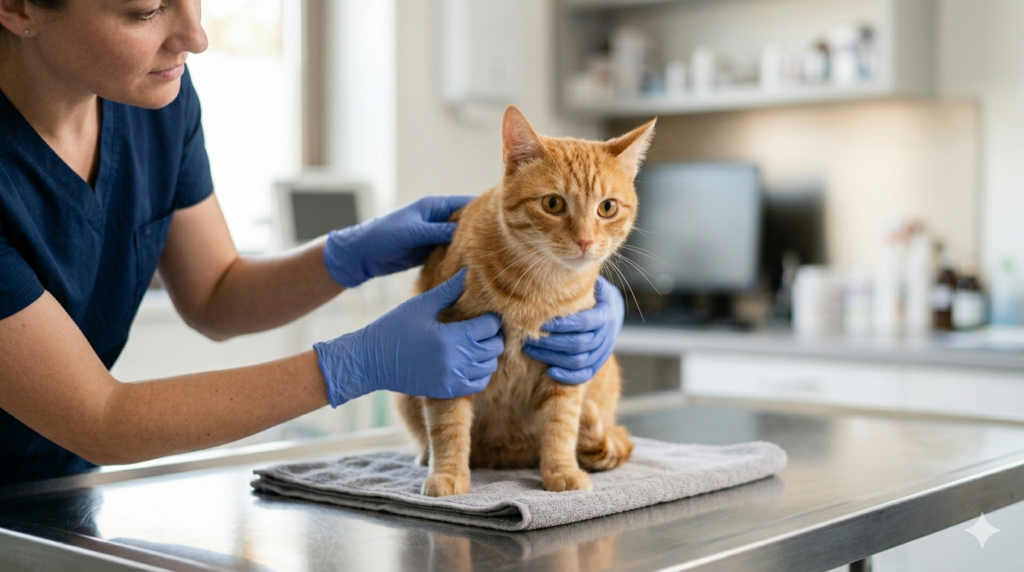
You sit down to pet your cat one evening and feel something off — a soft, warm lump where there wasn’t one yesterday. By morning it’s bigger, your cat won’t let you near it, and breakfast went untouched. That bump is very likely a cat abscess, and at Alta Animal Hospital, it’s one of the most common reasons cats walk through our doors here in Clovis.
The good news: most cat abscesses are highly treatable when caught early. The bad news: they can turn serious fast, especially in older cats or cats with weaker immune systems. This guide walks you through what a cat abscess actually is, how to spot one, what treatment looks like, and the warning signs that mean don’t wait.
What Is a Cat Abscess?
A cat abscess is a pocket of pus that forms beneath the skin when bacteria get trapped inside a wound. The cat’s immune system tries to wall off the infection by sending white blood cells to the area, and the resulting fluid collects into a swelling that grows over two to seven days.
Cats are unusually prone to this for a few reasons. Their teeth and claws deliver bacteria deep into muscle tissue. Their skin heals quickly — sometimes too quickly — sealing in any contamination from the original injury. And their grooming behavior often hides puncture wounds before owners notice them.
What Causes Cat Abscesses?
Bite Wounds from Cat Fights
Bite wounds are the leading cause we see in Clovis and Fresno cats. Whether your cat is going outdoors or living with a roommate cat that doesn’t get along, a bite delivers a heavy dose of oral bacteria — Pasteurella multocida most often — straight into the muscle. Within a few days, the surface wound seals over, the bacteria multiply, and an abscess forms.
There’s a saying in veterinary medicine that holds true: face wounds belong to the cat that stood and fought; rear-end and tail-base wounds belong to the cat that ran.
Scratches, Punctures, and Foreign Objects
Sticks, thorns, foxtails, sharp pieces of debris, and even nails can puncture the skin and drag bacteria with them. If a small piece of plant material stays inside the wound, the abscess will keep returning until it’s removed during drainage. We’ve pulled out tiny grass awns and splinters from cats whose owners had no idea they were there.
Tooth Root Abscess
Not every abscess starts on the outside. A cat’s tooth root can become infected when the tooth fractures or when severe periodontal disease lets bacteria reach the root. These typically appear as a swelling under the eye, along the jaw, or near the mouth — often without any visible wound.
Antibiotics alone won’t resolve a tooth root abscess. The diseased tooth has to come out. If your cat has facial swelling without an obvious external injury, a pet dentist near me visit with same-day dental imaging is the quickest path to answers.
Internal Abscesses
Less common but more serious, internal abscesses form when bacteria reach internal organs through the bloodstream — the liver, lungs, and pancreas being the most frequent sites. There’s no visible bump. The signs are vague: persistent fever, weight loss, low energy, and reduced appetite that won’t resolve. Diagnosis usually requires bloodwork and imaging from our in-house diagnostics lab.
Cat Abscess Symptoms to Watch For
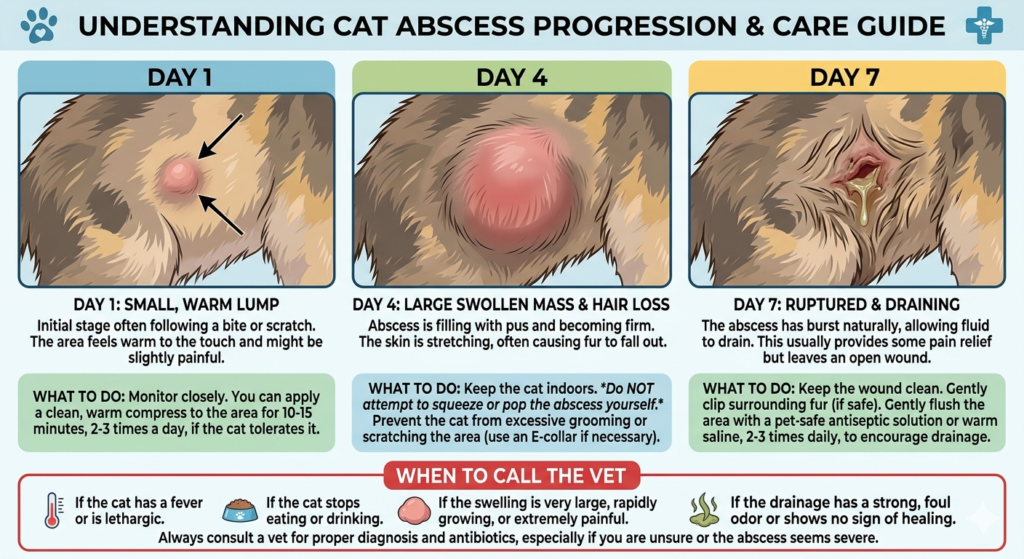
Cat abscesses move through predictable stages. Catching one early often means simpler, less invasive treatment.
Days 1 to 3 (early signs):
- A soft, warm swelling under the skin
- Your cat reacts when you touch the area — hissing, swatting, or pulling away
- Slight fever (ears feel warmer than usual)
- Mild loss of appetite or interest in play
Days 3 to 7 (established abscess):
- A firm, painful lump that may look red or discolored under the fur
- Hair thinning around the swelling as the skin stretches
- A visible scab or puncture mark at the original wound site
- Hiding, reduced grooming, longer naps
- Persistent fever above 103°F
When the abscess ruptures:
- Sudden discharge of yellow, green, or bloody pus, often with a strong, foul smell
- An open wound where the lump was
- Your cat may seem temporarily relieved as the pressure releases
A ruptured abscess still needs veterinary attention even if your cat looks better. The wound has to be flushed and cleaned to prevent it from re-sealing around contamination. If you’d like a broader overview of red-flag pet symptoms, our team’s piece on the signs your pet needs emergency vet care is a useful companion read.
Cat Abscess by Location: Face, Neck, Paw, and Tail Base
Where the abscess shows up usually tells us what happened.
Cat abscess on the face or cheek is most often a fight wound — though a tooth root infection is the second most common cause. Facial tissue is loose, so swelling can balloon quickly.
Neck abscesses are also fight-related in most cases. Old-style vaccines occasionally caused injection-site reactions, but modern protocols make this rare.
Paw abscesses typically involve a foreign object — a thorn, splinter, or piece of debris stuck between the toes. Cats limp, lick the paw obsessively, and refuse to put weight on it.
Tail base abscesses are nearly always bite wounds from a fleeing fight. They tend to run deeper than they look and need careful exploration during drainage.
How a Veterinarian Diagnoses and Treats a Cat Abscess
When you bring your cat into our walk-in clinic, the first step is a hands-on exam and a temperature check. Cats with active abscesses usually run fevers above 103°F. A fine-needle aspirate — a tiny needle drawing fluid from the lump — confirms whether we’re dealing with pus, a cyst, or a tumor.
For most surface abscesses, treatment looks like this:
- Sedate or anesthetize your cat (the procedure is too painful otherwise)
- Shave the surrounding fur and trim away any unhealthy skin
- Lance the abscess with a scalpel and flush the cavity with sterile saline
- Place a Penrose drain when the cavity is large, leaving it in for three to five days
- Send your cat home with antibiotics — Clavamox or a long-acting injectable like Convenia — plus pain medication such as meloxicam or robenacoxib
Tooth root abscesses follow a different path. The affected tooth has to be extracted under general anesthesia with full monitoring. Our pet surgery near me team handles both routine and complex surgical cases at our Clovis location.
Critical safety note: Never give your cat human pain relievers. Acetaminophen (Tylenol) causes fatal liver damage in cats. Ibuprofen and naproxen cause kidney failure and stomach ulcers. Only veterinarian-prescribed pain medication is safe.
Cat Abscess Home Care vs. Veterinary Treatment
| Aspect | Home Care Only | Veterinary Care |
|---|---|---|
| Diagnosis accuracy | Guesswork | Confirmed by exam and aspirate |
| Drainage | Incomplete or none | Full lance, flush, and drain |
| Pain management | No safe options for cats | Prescription pain meds |
| Antibiotics | Unavailable over the counter | Targeted prescription |
| Risk of recurrence | High | Low |
| Risk of sepsis | Significant | Minimal |
| Risk of foreign body remaining | Likely missed | Identified and removed |
| Recovery time | Often weeks longer | 10 to 14 days typical |
Case Study: A Clovis Cat Named Mango
Earlier this year, a long-time Clovis client brought in Mango, a six-year-old indoor-outdoor tabby. He’d been hiding under the bed for two days, refused his morning food, and his owner felt a lump near his right shoulder. She called our emergency vet clovis line and brought him in within the hour.
By arrival, the swelling was the size of a small lemon, and Mango’s temperature read 104.2°F. A quick aspirate pulled back thick yellow pus — a textbook abscess from a probable cat fight. Mango’s owner mentioned a stray had been hanging around the property at dusk.
We sedated him, opened and flushed the abscess, placed a drain, and started him on Convenia and meloxicam. Three days later he was eating normally and grooming again. By day ten, the wound had closed completely. His owner now keeps him indoors during the early evening, when most fights happen in our area.
Cases like Mango’s resolve cleanly when caught within the first few days. The cats that end up needing extensive surgery or hospitalization are usually the ones whose owners waited because the lump “wasn’t that big yet.”
When a Cat Abscess Becomes an Emergency
Some signs mean go in right away:
- Difficulty breathing or rapid, shallow breathing
- Pale, white, or grayish gums
- Collapse, weakness, or inability to stand
- Swelling near the throat that may compress the airway
- High fever combined with refusal to eat or drink for over 12 hours
- Foul-smelling discharge mixed with significant bleeding
- Confusion, disorientation, or unresponsiveness
Cats with FIV, FeLV, diabetes, or those on immunosuppressive medications face a higher risk of complications. They should be seen sooner rather than later, even for what looks like a minor abscess.
How to Prevent Cat Abscesses
Most preventable abscesses come down to reducing fight risk and catching wounds early.
- Limit unsupervised outdoor time. Most cat fights in the Central Valley happen at dawn and dusk.
- Spay or neuter your cat. Fixed cats fight far less frequently. Our spay & neuter surgery team performs these procedures routinely.
- Run your hands over your cat once a week. You’ll find lumps, scabs, and sore spots before they turn into something serious.
- Stay current on vaccines. Outdoor cats face higher exposure to FeLV, FIV (through bite wounds), and rabies. Our vaccinations & parasite prevention program builds risk-based plans for each pet.
- Clean visible puncture wounds quickly with a mild antiseptic, and call us if the skin closes over before you’re sure the wound is clean.
For broader guidance on bite-wound infection in cats, the Cornell Feline Health Center and the American Veterinary Medical Association both publish helpful owner-facing resources. The VCA Hospitals overview of feline abscesses is also a solid clinical reference, as is the American Animal Hospital Association library of pet owner articles.
Frequently Asked Questions About Cat Abscesses
-
How long does a cat abscess take to heal?
Most surface abscesses heal in 10 to 14 days once they’ve been properly drained and your cat is on antibiotics. The first few days involve drainage and inflammation, followed by tissue regeneration as the cavity closes. Tooth root abscesses take longer — often two to three weeks after the affected tooth is extracted. Cats with weakened immune systems or large wounds may need a month or more, which is why follow-up visits matter for catching healing issues early.
-
Can a cat abscess heal on its own without a vet?
Some small abscesses do rupture and drain on their own, and the cat seems to recover. But the underlying infection often persists, the wound can re-seal and refill, and bacteria can travel into deeper tissue or the bloodstream. Veterinary cleaning, prescription antibiotics, and proper pain control significantly cut the risk of complications including sepsis. Even a ruptured abscess that looks better needs professional evaluation to confirm complete healing and rule out foreign material left inside.
-
Is a cat abscess contagious to other pets or humans?
The pus contains bacteria like Pasteurella that can infect a person if it enters a fresh cut or scratch — so always wear gloves when cleaning a draining wound, and wash hands thoroughly afterward. The abscess itself does not spread between pets through casual contact. However, the cat-to-cat bite that caused the abscess can transmit serious diseases like FeLV and FIV, which is one important reason to have any fight wound professionally evaluated, not just cleaned at home.
-
What does a cat abscess smell like?
Ruptured cat abscesses produce a strong, foul, almost rotten odor that’s hard to mistake for anything else. The discharge is usually thick and yellow or greenish, sometimes streaked with blood. The smell comes from anaerobic bacteria thriving in the oxygen-poor environment inside a sealed abscess. If you suddenly notice a bad odor coming from your cat or their bedding, check carefully for a draining wound, contact your vet, and avoid pressing on or squeezing the area.
-
Should I try to drain my cat’s abscess at home?
No. Squeezing or lancing a closed abscess at home is intensely painful for your cat, can push bacteria deeper into surrounding tissue, and risks re-sealing the wound around contamination. A warm, damp compress applied gently for a few minutes can sometimes encourage natural rupture, but only do this if your veterinarian has specifically advised it. Proper drainage and cleaning require sterile instruments, sedation, and pain management — searching for a cat vet near me is always safer than home treatment.
-
When should I take my cat to an emergency vet for an abscess?
Go in immediately if your cat shows trouble breathing, pale gums, inability to stand, refusal to eat or drink for more than 12 hours, swelling near the throat, or a high fever paired with severe lethargy. Abscesses on the face that block vision or interfere with chewing also warrant urgent care. Any cat with FIV, FeLV, diabetes, or that is older than 12 should be seen sooner rather than later, even when the abscess looks minor.
-
Why do indoor cats sometimes get abscesses too?
Indoor cats are not immune. Roommate-cat fights — even brief tussles — can cause puncture wounds owners never witness. Indoor cats also get into things they shouldn’t, picking up splinters, sharp toy pieces, or even small bones that puncture the mouth. A weekly hands-on check is the easiest way to catch a hidden lump or scab early. If you notice any unexplained swelling, fever, or behavior change, the cat hospital near me option saves time over waiting and watching.
If you’ve found a suspicious lump on your cat or noticed any of the warning signs above, don’t wait — early treatment almost always means a faster, simpler recovery for your cat.