
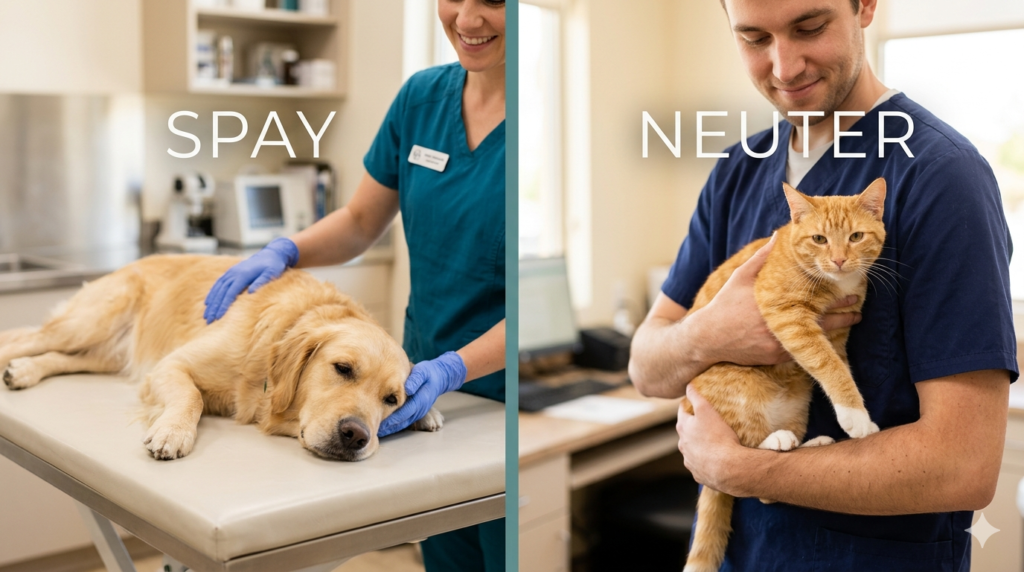
If you have brought home a new puppy or kitten, you have probably been asked the same question by your veterinarian, your neighbor, and the front desk team at every clinic you walk into: have you scheduled the spay or neuter yet? At Alta Animal Hospital, the difference between spay and neuter is one of the most common questions we hear from first-time pet parents in Clovis and Fresno, and the confusion makes complete sense. The two words get used interchangeably in casual conversation, on adoption paperwork, and across every pet-owner forum on the internet, but they describe two distinct procedures with different anatomy, different recovery curves, and different long-term health implications. This guide breaks down what each surgery actually does, when it should happen, and what you can realistically expect before, during, and after the procedure.
Spay vs Neuter: The Quick Answer
Here is the short version before we get into the medical detail. Spaying refers to the surgical sterilization of a female pet, while neutering refers to the surgical sterilization of a male pet. In professional veterinary language, “neuter” is technically a gender-neutral umbrella term that covers both procedures, but in everyday clinical use across the United States, “spay” almost always means the female surgery and “neuter” almost always means the male surgery. So when you hear a vet tech say “she is here for her spay” or “he is here for his neuter,” they are giving you a quick anatomical shorthand.
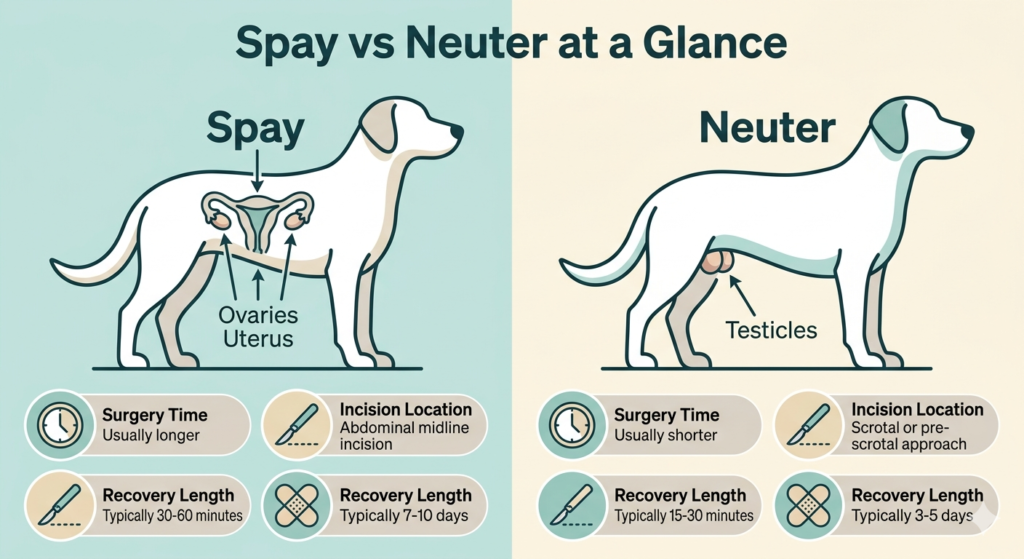
The medical names are different too. The female procedure is called an ovariohysterectomy (removal of the ovaries and uterus) or, in some modern protocols, an ovariectomy (removal of just the ovaries). The male procedure is called an orchiectomy or, more commonly, castration. Same goal — permanent sterilization and elimination of reproductive hormones — but the surgical approach, recovery time, and potential complication profile are not the same.
What Is Spay Surgery?
A spay is an abdominal surgery. Your veterinarian makes an incision through the body wall, locates the ovaries and uterus, ties off the blood supply, and removes the reproductive organs entirely. Because the surgeon is working inside the abdominal cavity, this is considered major surgery, even though it is one of the most routinely performed procedures in small animal medicine.
How a Spay Procedure Works
Before the surgery begins, your dog or cat is fasted overnight and given a thorough physical exam on the morning of the appointment. Pre-anesthetic bloodwork checks organ function and confirms she can safely process the anesthesia. An IV catheter is placed for fluids and emergency medication access. She is then induced with anesthesia, intubated, and connected to monitoring equipment that tracks heart rate, blood pressure, oxygen saturation, and temperature throughout the procedure.
The actual surgery typically takes between 30 and 90 minutes depending on the patient’s age, size, and whether she is in heat. A small midline incision is made just below the belly button. The surgeon carefully isolates each ovary, ligates the blood vessels, and removes the ovaries along with the uterus (or, in an ovariectomy, just the ovaries). The incision is closed in three layers — body wall, subcutaneous tissue, and skin — using absorbable sutures internally and either skin sutures or surgical adhesive on the outside.
Recovery After a Spay
The first 24 hours after a spay are the grogginess phase. Most pets come home a little wobbly, slightly disinterested in food, and ready to sleep off the anesthesia. Pain medication goes home with you, and strict activity restriction begins immediately. No running, no jumping on furniture, no rough play with other pets, and absolutely no licking the incision site. A standard recovery takes 10 to 14 days, with sutures typically removed at the two-week recheck if non-absorbable sutures were used.
What Is Neuter Surgery?
A standard neuter on a male dog or cat is a much shorter and less invasive procedure than a spay. The surgeon does not enter the abdominal cavity. Instead, a small incision is made in front of the scrotum, both testicles are removed, the spermatic cords and blood vessels are ligated, and the incision is closed. This is one of the reasons recovery tends to be faster and complications less common compared with the female procedure.
How a Neuter Procedure Works
Just like a spay, a neuter starts with fasting, an exam, and pre-surgical lab work. Anesthesia is induced and maintained the same way. The surgical site is shaved and sterilized. The veterinarian makes one incision (in dogs, just in front of the scrotum; in cats, directly through the scrotum) and removes both testicles. Most male neuters take between 15 and 45 minutes start to finish.
Cryptorchid males — pets with one or both testicles that never descended into the scrotum — require a more involved surgery to locate the retained testicle, sometimes inside the abdomen. This adds time, complexity, and recovery requirements, which is why catching a retained testicle during the puppy or kitten exam matters.
Recovery After a Neuter
Most male dogs and cats bounce back from a routine neuter within five to seven days. Activity restriction still applies for the full two weeks, because even though the incision is small, vigorous play can pull stitches and cause swelling or infection. Many pet parents are surprised at how quickly their pet wants to act normal — that is exactly when the cone, the leash walks, and the closed bedroom door become essential. We cover the full aftercare protocol in our pet surgical procedures overview.
Spay vs Neuter: Side-by-Side Comparison
Here is a quick reference table that lays out the main differences in plain terms:
| Factor | Spay (Female) | Neuter (Male) |
|---|---|---|
| Medical term | Ovariohysterectomy / Ovariectomy | Orchiectomy / Castration |
| Surgical site | Abdominal incision (midline) | Scrotal or pre-scrotal incision |
| Average surgery time | 30 to 90 minutes | 15 to 45 minutes |
| Tissue removed | Ovaries (and usually uterus) | Both testicles |
| Body cavity entered | Yes (abdomen) | No |
| Typical recovery | 10 to 14 days | 5 to 10 days |
| Activity restriction | 14 days | 14 days |
| Complication risk | Slightly higher (abdominal surgery) | Lower (less invasive) |
| Eliminates heat cycles | Yes | N/A |
| Reduces marking / roaming | Reduces in females | Significantly reduces in males |
Health Benefits of Spaying and Neutering
The argument for sterilization is not just about preventing unwanted litters. Both procedures carry well-documented medical and behavioral benefits that play out across your pet’s lifetime, which is why every major veterinary organization including the American Veterinary Medical Association strongly supports them. The AVMA spay and neuter guidance is a useful starting point if you want to read the position from the professional body itself.
Benefits for Female Pets
Spaying eliminates the risk of pyometra, a life-threatening uterine infection that can develop in any intact female and frequently requires emergency surgery. It also dramatically reduces the risk of mammary tumors, especially when the spay is performed before the first or second heat cycle. Beyond the cancer prevention angle, you also avoid the practical realities of heat cycles — the bleeding, the behavioral changes, the male dogs that show up uninvited at your front door.
Benefits for Male Pets
Neutering eliminates the risk of testicular cancer entirely (no testicles, no testicular tumors) and significantly reduces the incidence of certain prostate problems later in life. On the behavior side, neutered males are generally less likely to roam in search of mates, less likely to mark territory inside the home, and less prone to inter-male aggression — though it is worth noting that surgery is not a behavior fix on its own. According to ASPCA spay and neuter information, behavioral changes from neutering are often most pronounced when the procedure happens before sexual maturity is fully established.
When Is the Best Age to Spay or Neuter?
This is the part of the conversation where blanket recommendations do not work, and honestly, where the science has shifted in the last decade. The traditional advice was “six months across the board.” Current evidence-based guidelines from the American Animal Hospital Association recommend tailoring the timing to the species, breed, size, and individual lifestyle of the pet.
Dogs – Timing Considerations
For small-breed dogs (under 45 pounds at maturity), spay or neuter between six and nine months remains a reasonable window. For large and giant breeds, growing research suggests waiting until skeletal maturity — typically 12 to 18 months, sometimes longer for breeds like Great Danes — may reduce the risk of certain orthopedic problems and specific cancers. Your veterinarian will weigh breed-specific data, your dog’s living situation, and the practical risks of an unplanned pregnancy when making a recommendation.
Cats – Timing Considerations
Cats are simpler. Most veterinary organizations, including the Cornell Feline Health Center, recommend spay or neuter by five months of age, and ideally before the first heat cycle in females. Female cats can come into heat as early as four months, and a single accidental outdoor encounter at that age results in a full litter. The earlier-than-traditional recommendation reflects how prolific cats are as breeders and how quickly an unspayed female can contribute to local population pressure.
What to Expect on Surgery Day at Our Clovis Clinic
If you are searching for a spay neuter near me option in the Clovis or Fresno area, our spay and neuter clinic handles the procedure as a same-day surgery in most cases. You will drop your pet off in the morning after the overnight fast, our team will conduct a pre-surgical exam and bloodwork, and the surgery is performed during the daytime surgical block. We call you when your pet is awake and recovering comfortably, and most pets go home the same afternoon with detailed written discharge instructions, pain medication, and an Elizabethan collar.
Pre-surgical communication matters. Our intake team will ask about your pet’s full medical history, any medications, allergies, and recent illnesses. If you have an older pet who is being spayed or neutered later in life — which is more common than people think — additional bloodwork and an assessment from our senior pet care protocol may be added to make sure anesthesia is safe.
Aftercare and Recovery: A Practical Roadmap
The two-week recovery window is the part that catches most pet parents off guard. The surgery is the easy part — keeping a bouncy young dog or playful kitten quiet for fourteen days is the actual challenge. Here is what realistic at-home aftercare looks like:
- Keep the incision dry. No baths, no swimming, no wet grass on belly walks for 14 days
- Use the cone (or a recovery suit). Even pets that “would never lick the stitches” lick the stitches the moment you turn around
- Restrict activity. Short leash walks for bathroom only, no stairs if avoidable, no jumping on or off furniture
- Watch the incision daily. Mild bruising is normal. Heat, swelling, discharge, or a gap in the skin is not — call your vet
- Monitor appetite. Most pets eat lightly the first night and return to normal within 24 to 48 hours
Pain management has come a long way. Modern protocols use multimodal pain control — usually a combination of local anesthetic, NSAIDs, and sometimes longer-acting injectable analgesics — so the days of pets coming home miserable after a routine sterilization are mostly behind us.
Real Patient Story: Bella’s Spay Recovery
Bella, a one-year-old Lab mix from Clovis, came in for her spay last spring. Her owner had adopted her from a local rescue, and we performed her surgery alongside her booster puppy vaccines and a full wellness exam. Pre-surgical bloodwork came back clean, anesthesia was uneventful, and the procedure took about 45 minutes from first incision to final suture. By the next morning, Bella was eating breakfast, mildly annoyed with her cone, and ready to ignore every “no jumping” rule her owner tried to enforce. Her two-week recheck showed a perfectly healed incision and a happy, healthy young dog. Her owner later told us that the hardest part of the whole experience was not the surgery — it was convincing a one-year-old Lab to nap for two weeks straight. Bella’s case is genuinely typical: in our experience, the vast majority of routine spays and neuters look exactly like this when the patient is healthy, the surgery is performed with proper monitoring, and the owner sticks to the aftercare plan.
Common Myths About Spay and Neuter Surgery
A few persistent myths come up in conversation with new pet owners, and they are worth addressing directly:
- “My pet will get fat after surgery.” Surgery does slightly slow metabolism, but weight gain comes from overfeeding and underexercising — both of which are fixable. We discuss diet adjustments at the post-op recheck
- “Females should have one litter first.” No medical evidence supports this. The cancer-prevention benefit is actually strongest when the spay happens before the first heat
- “Neutering will change my dog’s personality.” It removes hormonally driven behaviors (roaming, marking, mounting) but does not change core temperament or trainability
- “Indoor cats don’t need to be fixed.” Indoor cats escape, indoor cats spray, and intact females still come into heat with all the noise and behavioral changes that involves
If you have heard a piece of advice that does not sit right with you, ask your veterinarian to walk you through the actual data. There is a lot of outdated information circulating online, and a quick conversation almost always clears it up faster than an evening of internet research.
Final Thoughts
Choosing to spay or neuter your pet is one of the most consequential decisions you will make for their long-term health, and understanding the difference between the two procedures is the first step in making that decision with confidence. Whether you are planning ahead for a new puppy, scheduling for an adult cat that came home unfixed, or finally getting around to it after years of putting it off — the procedure is well-understood, well-tolerated, and supported by decades of veterinary evidence.
If you are ready to schedule, or you just want to talk through the timing for your specific pet, our team in Clovis is here to walk you through it.
Frequently Asked Questions
-
Is spaying or neutering painful for pets?
Modern veterinary anesthesia and multimodal pain management have made spay and neuter procedures far more comfortable than they were a generation ago. Pets receive pain control before, during, and after surgery using a combination of local anesthetics, anti-inflammatories, and longer-acting analgesics that go home with you. Most patients show only mild discomfort during the first 24 hours, and a normal appetite and energy level typically return within two to three days.
-
How long does it take a pet to fully recover from spay or neuter surgery?
Standard recovery for a routine neuter takes about five to seven days, while a spay typically takes the full ten to fourteen days because it is an abdominal procedure. Activity restriction and incision protection apply for the entire two weeks regardless of how energetic your pet looks. Sutures, if non-absorbable, are removed at the two-week recheck appointment. Older pets and large breeds occasionally need an extra few days for complete healing, especially after a spay.
-
Can my pet eat normally after spay or neuter surgery?
Most pets are mildly nauseous the first night after anesthesia and will pick at food rather than eat enthusiastically. Offer a small portion of their regular diet that evening, and full meals can resume the next morning if they tolerate the smaller amount well. Vomiting once after coming home is fairly common from anesthesia. Repeated vomiting, refusal to eat for more than 24 hours, or signs of bloating warrant a call to your vet.
-
What is the difference between spay and neuter and at what age should each happen?
The difference between spay and neuter comes down to anatomy: spaying is performed on females and removes the ovaries (and usually uterus), while neutering is performed on males and removes the testicles. For cats, both procedures are typically recommended by five months of age. For dogs, timing depends on breed and size, ranging from six months for small breeds to twelve to eighteen months for large and giant breeds. Your vet will tailor the recommendation to your specific pet.
-
Do indoor cats really need to be spayed or neutered?
Yes. Indoor cats escape more often than people expect, and intact cats have a strong drive to find mates the moment a door opens. Even cats that genuinely never go outside experience significant behavioral changes — yowling, restlessness, urine spraying, and territorial marking — when they reach sexual maturity. Spaying and neutering eliminates these behaviors and prevents reproductive cancers and infections that develop in older intact pets.
-
How do I know if I’m choosing the right vet for my pet’s spay or neuter procedure?
Look for a clinic that uses pre-surgical bloodwork, dedicated anesthesia monitoring, and multimodal pain control as standard practice — not as upgrades. Ask about the veterinarian’s experience with your specific breed, the recovery protocol they recommend, and how they handle post-surgical complications. We have a more detailed guide on how to choose the best veterinarian in Clovis that walks through the full evaluation checklist for any major procedure.