
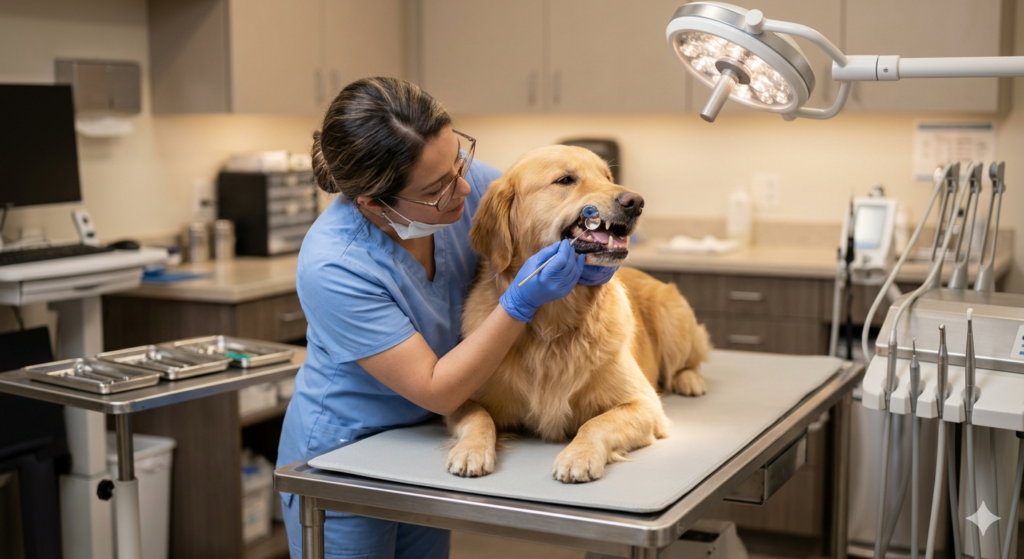
Most dog owners accept that their pets need annual vaccinations, regular exams, and monthly parasite prevention. Dental care, though, tends to fall off the list. It should not. By the time a dog reaches age three, the majority already have some degree of periodontal disease, and by five or six the damage can be significant enough to affect the heart, kidneys, and liver. A professional dog dental cleaning is not a cosmetic procedure. It is one of the most impactful things you can do for your pet’s long-term health, comfort, and quality of life.
If you have been searching for a dog dentist near me or pet dentistry near me in the Clovis or Fresno area and wondering what actually happens during a professional cleaning, this guide walks you through the entire process from the initial exam to recovery at home. No surprises, no guesswork, just a clear picture of what to expect and why veterinarians consider dental cleanings essential.
Why Professional Dog Dental Cleaning Matters More Than You Think
The visible tartar caked along your dog’s gum line is only the surface problem. Below that buildup, bacteria form colonies in the pockets between the gums and tooth roots. Over time, this bacterial load erodes the bone and connective tissue that hold teeth in place. That process is periodontal disease, and once it reaches the later stages, the damage is irreversible.
What makes periodontal disease dangerous beyond the mouth is the systemic connection. Bacteria from infected gums enter the bloodstream every time your dog chews. Research published through the American Veterinary Medical Association (AVMA) has established links between chronic oral infection in dogs and organ damage, particularly to the heart valves, kidneys, and liver. Dogs with untreated dental disease also suffer in ways that owners may not immediately attribute to their teeth: decreased appetite, reluctance to play with toys, pawing at the face, drooling, and a general decline in energy that gets written off as aging.
A professional dental cleaning removes the bacteria, tartar, and diseased tissue that brushing alone cannot reach. It gives the veterinarian a chance to identify cracked teeth, oral tumors, root abscesses, and bone loss that are invisible without dental X-rays. For many dogs, a dental cleaning is the single appointment that uncovers problems the owner had no idea existed.
What Happens Before Your Dog’s Dental Cleaning
The cleaning itself is only one part of the appointment. What happens before and after is just as important.
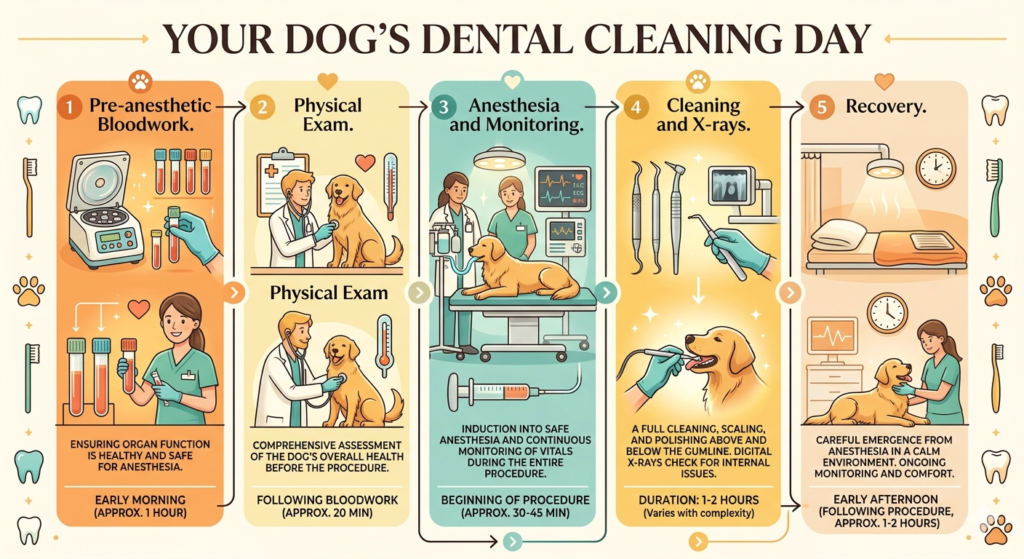
Pre-Anesthetic Bloodwork
Every dog receiving anesthesia at a responsible veterinary practice will have pre-anesthetic bloodwork done either the day of the procedure or within a few days prior. This panel evaluates liver function, kidney function, blood sugar, electrolyte balance, and red and white blood cell counts. The purpose is to confirm that your dog can safely metabolize anesthesia and recover normally. Dogs with underlying conditions such as kidney disease, liver compromise, or anemia may need adjusted anesthetic protocols, additional IV fluid support, or in some cases a postponement until the underlying issue is stabilized.
Pre-anesthetic testing is especially important for senior dogs and breeds known for anesthetic sensitivity, including brachycephalic breeds like bulldogs and pugs. This is not a formality. It has saved lives by catching problems that had no outward symptoms.
Physical Exam and Risk Assessment
Before any sedation, the veterinarian performs a focused physical exam. Heart and lung sounds are evaluated. If a heart murmur is detected for the first time, additional diagnostics may be recommended before proceeding. The vet also looks at the visible oral structures to develop a preliminary treatment plan, though the full assessment can only happen once the dog is under anesthesia and the mouth can be thoroughly examined.
Step by Step: What Happens During a Professional Dog Dental Cleaning
Understanding the procedure removes most of the anxiety owners feel. A professional veterinary dental cleaning follows a structured sequence designed to be thorough, safe, and as efficient as possible to keep anesthesia time short.
Anesthesia and Continuous Monitoring
Once your dog is sedated and intubated, a veterinary technician monitors vital signs throughout the entire procedure. This includes heart rate, respiratory rate, blood pressure, oxygen saturation, body temperature, and anesthetic depth. Modern monitoring equipment provides real-time data that allows the team to make immediate adjustments if anything changes. An IV catheter delivers fluids to maintain hydration and blood pressure, and also provides immediate vascular access if emergency medications are ever needed.
The endotracheal tube serves a dual purpose. It delivers the anesthetic gas and oxygen, and it protects the airway from water, debris, and bacteria that are flushed out of the mouth during the cleaning process. This is one of the key reasons why anesthesia-free dental cleanings, sometimes marketed as a safer alternative, actually leave important safety gaps. Without intubation, contaminated water and bacteria can be aspirated into the lungs.
Full Oral Examination and Digital Dental X-Rays
With the dog anesthetized, the veterinarian can now do what is impossible on a conscious patient: a complete, tooth-by-tooth examination. Each tooth is probed for pocket depth along the gum line. Healthy pockets in dogs measure one to three millimeters. Anything deeper indicates bone loss and active periodontal disease.
Digital dental X-rays are taken of the full mouth. This is arguably the most critical step. Roughly 60 percent of dental disease in dogs exists below the gum line where it is completely invisible to the naked eye. X-rays reveal root abscesses, fractured roots, jaw bone loss, retained tooth roots, and tumors that would otherwise go undiagnosed. A cleaning without X-rays is incomplete because it only addresses what you can see, not what is actually happening.
The American Animal Hospital Association (AAHA) includes full-mouth dental radiographs as a standard component of every professional dental cleaning in their 2019 dental care guidelines.
Scaling, Polishing, and Extractions
After the examination and X-rays, the cleaning begins. An ultrasonic scaler uses high-frequency vibrations combined with a water spray to break apart tartar above and below the gum line. This is followed by hand scaling of any remaining deposits in difficult-to-reach areas, particularly along the inner surfaces of the teeth and in the deeper gum pockets.
Once all tartar is removed, each tooth is polished with a fine prophy paste. Polishing smooths the microscopic scratches left by scaling, which is important because rough enamel surfaces attract and hold bacteria much faster than smooth ones. Skipping this step means tartar rebuilds more quickly after the cleaning.
If the X-rays or probing revealed teeth that are fractured, severely infected, or have significant bone loss around the roots, the veterinarian will perform extractions during the same procedure. Extracting a diseased tooth that is causing pain and harboring infection is always better for the dog than leaving it in place. The extraction sites are flushed, and in some cases sutured with dissolvable stitches that do not need to be removed later.
Charting and Documentation
Every finding is recorded on a dental chart: pocket depths, missing teeth, extractions performed, areas of concern for future monitoring. This chart becomes part of your dog’s permanent medical record and allows the veterinarian to track changes over time at subsequent cleanings.
Anesthesia Safety: Addressing the Most Common Concern
Anesthesia anxiety is the number one reason dog owners delay or avoid dental cleanings. It is a valid concern, but the actual risk, when proper protocols are followed, is very low. Modern veterinary anesthesia is safer than it has ever been. The combination of pre-anesthetic screening, balanced anesthetic protocols tailored to the individual patient, continuous monitoring, and IV fluid support has reduced anesthesia-related complications dramatically over the past two decades.
The risk of not treating dental disease is concrete and cumulative. Chronic oral infection causes measurable organ damage over time. Painful teeth reduce quality of life in ways dogs cannot communicate clearly. By the time most owners notice signs of dental pain, the disease has been progressing for months or years.
For owners who remain concerned, here is a practical framework: if your dog’s bloodwork comes back normal and the physical exam does not reveal any cardiac or respiratory red flags, the anesthetic risk for a routine dental cleaning is extremely low. The benefit of removing disease, pain, and chronic infection far outweighs that risk in the vast majority of cases.
Recovery Timeline After a Professional Dog Dental Cleaning
Most dogs recover from a routine dental cleaning faster than their owners expect. Here is a general timeline, though individual experiences vary based on whether extractions were performed and the overall health of the dog.
Day of the procedure: Your dog will be groggy for several hours after returning home. Mild disorientation, unsteady walking, and drowsiness are all normal effects of anesthesia wearing off. Offer a small amount of water once your dog is steady on their feet, and feed a soft meal in the evening. Most dogs eat willingly the same night, especially if no extractions were done.
Days one through three: If extractions were performed, expect some jaw tenderness and mild swelling. Soft food is recommended during this window. Most veterinarians prescribe a short course of pain medication and sometimes antibiotics if significant infection was present. Avoid hard chew toys, bones, and tug games during this period.
Days four through seven: The majority of dogs return to completely normal eating, energy, and behavior within a week. Extraction sites heal rapidly in the mouth due to the excellent blood supply. Dissolvable sutures typically break down on their own within ten to fourteen days.
Two-week follow-up: For dogs that had multiple extractions or complex procedures, a brief recheck may be scheduled to confirm the surgical sites are healing properly and the dog is comfortable.
Many owners report that their dog seems happier and more energetic after a dental cleaning, especially when painful teeth were removed. Dogs are remarkably stoic about oral pain, and owners often do not realize how much discomfort their pet was living with until the problem is resolved.
How Often Does Your Dog Need a Professional Dental Cleaning?
There is no universal answer because dental disease progresses at different rates depending on breed, genetics, diet, and home care habits. Small breeds and toy breeds such as Yorkshire Terriers, Chihuahuas, Dachshunds, and Pomeranians tend to develop dental disease faster and more severely than larger breeds. These dogs often need annual cleanings starting as early as age two.
Larger breeds with wider tooth spacing and stronger jaw bones may go longer between cleanings, but they are more prone to fractured teeth from chewing on hard objects, which creates its own set of problems.
As a general guideline, most veterinarians recommend annual dental evaluations starting at age one, with professional cleanings scheduled as needed based on the findings. Some dogs need cleanings every year. Others can go eighteen months to two years between procedures. Your veterinarian will advise based on your dog’s individual oral health status.
Professional Dental Cleaning vs. At-Home Dental Care
Owners sometimes wonder whether consistent brushing at home can replace professional cleanings entirely. It cannot, but it absolutely extends the interval between them and slows the progression of disease. Think of it the same way you think about your own teeth: brushing every day does not eliminate the need for professional cleanings at the dentist, but it makes each visit easier and less costly.
| Factor | Professional Cleaning | At-Home Care |
|---|---|---|
| Removes tartar below the gum line | Yes | No |
| Identifies hidden disease via X-rays | Yes | No |
| Removes mineralized tartar (calculus) | Yes | No (only prevents buildup) |
| Addresses fractured or infected teeth | Yes | No |
| Requires anesthesia | Yes | No |
| Frequency | Typically annual | Daily brushing recommended |
| Products recommended | Veterinary-grade tools | VOHC-accepted toothpaste, dental chews |
| Role in overall dental health | Treatment and diagnosis | Prevention and maintenance |
The Veterinary Oral Health Council (VOHC) maintains a list of dental products for dogs that have met defined standards for reducing plaque or tartar. Choosing VOHC-accepted dental chews and toothpastes ensures you are using products that actually work rather than relying on marketing claims.
Case Study: Bella’s Hidden Dental Emergency
A six-year-old Labrador mix named Bella came in for what her owners expected would be a routine dental cleaning. Bella had mild tartar buildup along her upper premolars and moderately bad breath, but she was eating normally, playing fetch daily, and showed no obvious signs of oral pain.
Pre-anesthetic bloodwork came back within normal limits, and the procedure went ahead as planned. Once Bella was under anesthesia and digital X-rays were taken, the veterinarian discovered a fractured upper carnassial tooth with a root abscess that had eroded into the bone. On the outside, the tooth looked largely intact. Below the gum line, the root was dead and infected.
The tooth was extracted, the abscess was debrided and flushed, and Bella went home that afternoon with pain medication and a short course of antibiotics. Within three days she was eating normally, and within a week her owners noticed something they had not expected: Bella was more playful, more enthusiastic about meals, and more willing to engage with her toys than she had been in months. The infection had been causing low-grade pain for what was likely a very long time, and Bella had simply adapted to it without showing obvious signs.
This is the scenario veterinarians encounter regularly. Dental X-rays found a problem that a visual exam alone would have missed entirely. Without the cleaning, that abscess would have continued to destroy bone, seed bacteria into the bloodstream, and cause pain that Bella could not communicate.
What to Look For Between Dental Cleanings
Between professional cleanings, watch for these warning signs that your dog may have developing dental issues:
- Persistent bad breath that does not improve with dental chews or brushing
- Red, swollen, or bleeding gums, especially along the back upper teeth
- Yellow or brown buildup along the gum line
- Loose or visibly broken teeth
- Dropping food while eating, chewing on one side, or reluctance to eat hard kibble
- Excessive drooling or drooling with blood-tinged saliva
- Pawing at the mouth or rubbing the face on furniture or carpet
- Facial swelling below the eye, which often indicates a carnassial tooth root abscess
Any of these signs warrant a veterinary exam rather than a wait-and-see approach. Dental infections do not resolve on their own, and catching problems early means simpler treatment and a faster recovery.
For dog owners in Clovis or Fresno searching for a pet dentist near me or dog dental cleaning near me, the first step is a conversation with your veterinarian about your dog’s current oral health and whether a professional cleaning is due. Most dogs benefit enormously, and many owners wish they had not waited as long as they did.
Your dog cannot tell you that a tooth hurts. A dental cleaning is how your veterinarian finds out for them.
Frequently Asked Questions About Dog Dental Cleaning
-
Is anesthesia really necessary for a dog dental cleaning?
Yes, and for good reasons. A thorough dental cleaning requires scaling below the gum line, taking diagnostic X-rays, probing each tooth for pocket depth, and potentially extracting diseased teeth. None of this is possible on a conscious dog that is stressed, moving, and biting down reflexively. The endotracheal tube placed during anesthesia also protects the airway from water, bacteria, and debris that are flushed out during cleaning. Anesthesia-free dental procedures address only visible tartar on tooth surfaces and miss the disease happening below the gum line.
-
How long does a professional dog dental cleaning take?
A routine cleaning without extractions typically takes 45 minutes to one hour from anesthesia induction to recovery. If extractions or additional surgical procedures are needed, the total time may extend to 90 minutes or longer depending on the complexity. Your veterinary team will give you a time estimate after the pre-procedure exam and will contact you during the procedure if unexpected findings change the plan or timeline.
-
At what age should my dog have its first dental cleaning?
Most veterinarians recommend the first professional dental evaluation around age one, with a cleaning scheduled whenever significant tartar buildup or early periodontal changes are detected. Small and toy breeds often need their first cleaning between ages two and three because their crowded teeth accumulate plaque faster. Large breeds may not need a cleaning until age three or four, but this varies by individual. Annual oral exams catch problems before they escalate.
-
Can I brush my dog’s teeth instead of getting a professional cleaning?
Daily brushing is excellent preventive care and significantly slows plaque and tartar buildup. However, brushing cannot remove mineralized tartar that has already formed, cannot reach below the gum line where periodontal disease develops, and cannot replace the diagnostic value of dental X-rays. Think of brushing as maintenance between professional cleanings, not a replacement. Use a dog-specific enzymatic toothpaste and a soft-bristled brush. Never use human toothpaste because it contains fluoride and xylitol, both of which are toxic to dogs.
-
What should I feed my dog after a dental cleaning?
On the day of the procedure, offer a small soft meal once your dog is fully alert and steady on their feet. For the first three to five days after a cleaning with extractions, stick to softened kibble or canned food to avoid irritating the surgical sites. Dogs that had a cleaning without extractions can usually return to their normal diet the following day. Your veterinarian will provide specific feeding instructions based on what was done during your dog’s procedure.
-
How do I find a qualified dog dentist near me?
Start with your regular veterinarian. Most full-service veterinary hospitals in the Clovis and Fresno area perform professional dental cleanings as a core service, including pre-anesthetic bloodwork, digital dental X-rays, ultrasonic scaling, polishing, and extractions when needed. If your dog requires advanced oral surgery such as root canal therapy, jaw fracture repair, or orthodontic work, your veterinarian can refer you to a board-certified veterinary dentist. For routine cleanings and extractions, a well-equipped general practice veterinary hospital provides everything your dog needs.