
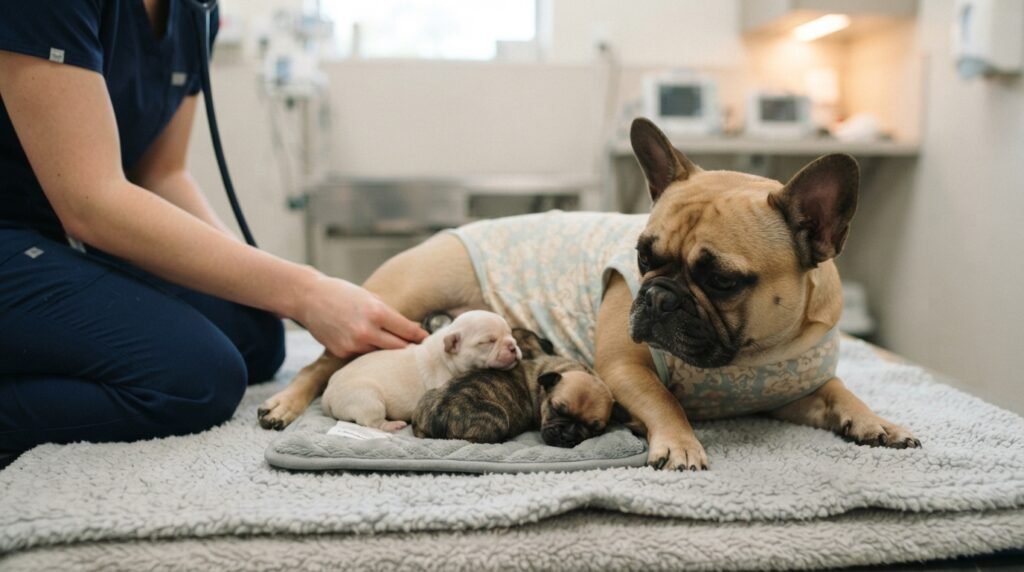
If you own a female Frenchie and you’re thinking about a litter, the most useful thing to know early is this: a French bulldog C-section in Clovis, CA is not a backup plan, it’s usually the plan. Most French bulldogs can’t safely deliver puppies on their own, and the dogs that run into trouble mid-labor face real risks from both the birth and the emergency anesthesia that follows. This guide from your local animal hospital near me explains why Frenchies need C-sections so often, how vets manage brachycephalic anesthesia, how to time a planned surgery, and how to care for mom and puppies afterward.
Why Do French Bulldogs Need C-Sections?
What the Data Shows
A large UK study of pedigree litters, built on Kennel Club and BSAVA survey data, found that in Boston terriers, bulldogs, and French bulldogs, more than 80 percent of litters were delivered by C-section (Journal of Small Animal Practice). French bulldogs came in at 81.3 percent.
Later work from the Royal Veterinary College VetCompass program added two more numbers worth knowing:
| Finding | French Bulldog Compared With Crossbreeds |
|---|---|
| Likelihood of a difficult birth (dystocia) | 15.9 times higher |
| Likelihood of a C-section once dystocia occurs | 2.4 times higher |
| Share of litters born by C-section (Kennel Club survey) | 81.3% |
Put simply, a Frenchie is far more likely to get stuck in labor, and once she does, surgery is far more likely to be the fix.
Narrow Pelvis, Big Heads
The problem is built into the breed’s shape. French bulldogs have been selected for a large, broad head, wide shoulders, and a compact, narrow-hipped body. Their puppies inherit the same big heads. When a puppy’s skull is wider than the mother’s pelvic canal, no amount of pushing will get it through.
Other factors stack on top of that:
- Small litters. One or two puppies may not produce enough hormonal signal to kick labor into gear.
- Weak contractions. Frenchies often tire quickly, and the uterus can stop contracting effectively (uterine inertia).
- Breathing effort. Labor is hard physical work, and a dog with a restricted airway struggles to pant, cool down, and keep pushing at the same time.
Can French Bulldogs Give Birth Naturally?
Some can. A Frenchie with a roomier pelvis, a moderate head shape, and a small litter of normally sized puppies may whelp without help. The trouble is that nobody can promise which dogs will manage it, and when natural birth fails in this breed, it tends to fail at the worst moment: hours into labor, with an exhausted mom and stressed puppies. That’s why most breeders and veterinarians plan a C-section from the start. For a broader look at the procedure itself, including the general signs of labor trouble, read our full guide to the dog C-section.
Before Breeding: Weight, Fitness, and Airway Health
The safest C-section starts months before the pregnancy does.
Get her to a lean weight. Extra fat sits around the chest and neck, makes breathing harder, and raises anesthetic risk. It also tends to mean bigger puppies and harder deliveries. If she needs to slim down, nutritional counseling can set a realistic target and timeline.
Build basic fitness. Short, regular walks in cool parts of the day improve stamina without overheating her.
Check her airway. Noisy breathing at rest, snoring, gagging, or tiring quickly on walks can point to brachycephalic obstructive airway syndrome (BOAS). A dog with significant BOAS is a higher anesthetic risk and may pass the same anatomy to her puppies. In the UK, the Kennel Club and University of Cambridge run a respiratory grading scheme for exactly this reason.
Start with a full exam. A pre-breeding adult pet wellness exam covers her heart, airway, weight, vaccines, and parasite status, and gives you a baseline before pregnancy changes everything.
French Bulldog Pregnancy: Planning the C-Section
A French bulldog pregnancy lasts about 63 days from ovulation. That date matters more than the breeding date, because operating even a few days early can leave puppies with lungs that aren’t ready to breathe.
The planning sequence usually looks like this:
- Progesterone testing during heat to pinpoint ovulation. Many Frenchies are bred by artificial insemination, so this testing is often already part of the process.
- Ultrasound around day 25 to 30 to confirm the pregnancy and check heartbeats.
- X-ray around day 55 to count puppies once their skeletons are visible and compare head size to mom’s pelvis.
- Pre-surgical bloodwork and an airway check a few days before surgery.
- Surgery around day 61 to 63 from ovulation, ideally before labor starts.
How Many Puppies Do French Bulldogs Have?
French bulldogs usually carry small litters, most often two to four puppies, with three being typical. Singletons happen too. The day 55 X-ray count is what tells the surgical team how many resuscitation stations to prepare, and it’s how everyone knows the uterus is empty before closing.
Why Book Before Labor Starts
With most breeds, vets can wait for early labor and then operate. With Frenchies, waiting carries extra cost. A dog in labor pants hard, heats up, swallows air, and may have eaten recently, which raises the risk of regurgitation under anesthesia. Scheduling surgery on a calm, fasted, rested dog removes most of those problems. If labor does start early, call right away and review when to take a dog to the emergency vet so you’re not second-guessing at 2 a.m.
Brachycephalic Dog Anesthesia: The Real Risk and How Vets Reduce It
What Makes Anesthesia Harder
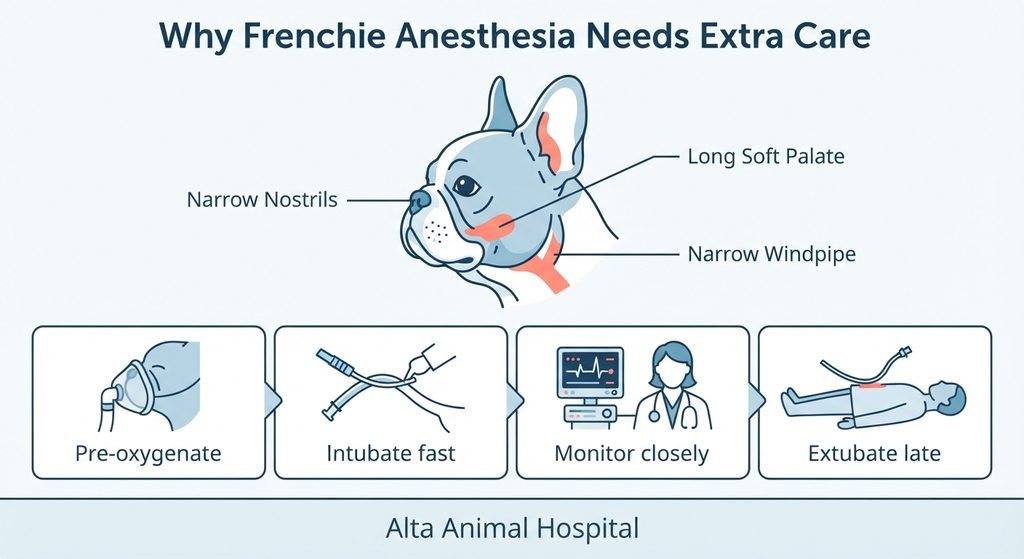
Flat-faced dogs often have narrowed nostrils, an elongated soft palate, everted tissue in the larynx, and a narrow trachea. Under sedation, those soft tissues relax and can block the airway. Brachycephalic dogs also regurgitate more often, and stomach contents reaching the lungs can cause aspiration pneumonia.
According to a review in Today’s Veterinary Practice, dogs with BOAS are about twice as likely to have anesthetic complications as other dogs, and most of those problems show up during recovery, not on the table. Recovery is the window that needs the closest watching.
How Vets Reduce the Risk
A C-section adds a second patient group, the puppies, so the plan has to protect everyone at once. Common steps include:
- Anti-nausea and antacid medication before surgery to cut regurgitation risk
- Pre-oxygenation with a mask for several minutes before induction
- Clipping and scrubbing the belly while she’s awake to shorten anesthesia time
- Fast induction and immediate intubation, with several smaller tube sizes ready because Frenchie tracheas often run narrow
- A local anesthetic block at the incision so less general anesthetic is needed
- Continuous monitoring of heart rate, oxygen, and temperature
- Delayed extubation, keeping the breathing tube in until she is awake, lifting her head, and swallowing well
- Recovery on her chest in a cool, quiet area with a team member watching her breathing
Our pet surgery near me team runs in-house pre-anesthetic bloodwork and monitors every patient through recovery. If you’re comparing options, our guide to choosing a vet hospital equipped for surgery explains what to ask before booking.
Planned vs Emergency French Bulldog C-Section
| Factor | Planned C-Section | Emergency C-Section |
|---|---|---|
| Mom’s state | Rested, fasted, calm | Exhausted, overheated, possibly fed |
| Airway risk | Lower, with time to prepare | Higher, with less control over timing |
| Puppies | Not stressed by prolonged labor | May be oxygen-deprived |
| Team | Full resuscitation team scheduled | Assembled under time pressure |
| Overall cost tendency | Usually lower | Usually higher due to stabilization and added care |
French Bulldog C-Section Cost Factors
We don’t quote fixed fees, because every case is different. The final cost of a French bulldog C-section depends on:
- Whether the surgery is planned or an emergency
- Pre-surgical testing such as progesterone, ultrasound, X-ray, and bloodwork
- Number of puppies and how much resuscitation they need
- Anesthesia time and recovery monitoring
- Whether a spay is added
- Any overnight stay or extra care for weak puppies
A planned surgery lets you get an estimate weeks ahead instead of in the middle of a crisis.
Newborn Frenchie Checks: Cleft Palate, Breathing, and Swallowing
Brachycephalic puppies are more likely to be born with certain defects, so every newborn Frenchie gets a careful once-over right after delivery.
| Check | What the Team Looks For | Why It Matters |
|---|---|---|
| Roof of the mouth | A gap in the hard or soft palate (cleft palate) | Milk can enter the nose and lungs |
| Breathing | Steady breaths, pink gums, no gasping | Spots puppies needing oxygen or more stimulation |
| Suckle and swallow | Strong suckle on a finger, no milk from the nose | Confirms the puppy can nurse safely |
| Body and belly | Umbilical hernia, abdominal wall defects | Some need monitoring or later repair |
| Activity | Squirming, crying, rooting for warmth | Weak puppies need closer watching |
At home, weigh each puppy daily on a gram scale and watch for milk bubbling from the nose, constant crying, or a puppy that stays cold and quiet. Book their first exam using our first vet visit checklist so nothing gets missed.
French Bulldog C-Section Recovery and Nursing
Heat Sensitivity After Surgery
Here’s the tricky part. Newborn puppies need warmth, often 85 to 90°F in their immediate space for the first few days. A post-surgical Frenchie mom, on the other hand, overheats easily. AAHA notes that flat-faced breeds can’t pant effectively to cool down.
The fix is to heat the puppies, not the room:
- Keep the room cool and well ventilated, especially through Clovis summers.
- Put a covered heating pad under one side of the whelping box only, so puppies can snuggle there while mom lies on the cool side.
- Give her constant access to fresh water.
- Watch for loud, labored panting, a bright red tongue, or restlessness she can’t settle from. Those are signs she’s overheating.
Incision Care and Nursing
Most incisions heal in 10 to 14 days. Check the incision twice daily, keep her bedding clean, and limit her to short leash walks. Buried stitches let puppies nurse without irritating the wound. Her take-home pain medication is chosen to be safe for nursing, so never substitute anything from your own medicine cabinet.
Supervise the first few nursing sessions. A groggy Frenchie can lie on a puppy without noticing, and her broad chest makes that easier than you’d think.
Warning Signs After Surgery
Call us right away if you see:
- Coughing, fast breathing, or noisy breathing that’s worse than before surgery (possible aspiration pneumonia)
- Repeated regurgitation or vomiting
- Discharge, swelling, or gaping at the incision
- Panting, trembling, stiffness, or wobbling in the first few weeks (possible eclampsia, a drop in blood calcium)
- Hot, hard, or discolored mammary glands
- Rejecting the puppies or refusing food for more than a day
The Ethics of Repeat C-Sections
Every C-section is major abdominal surgery under general anesthesia, and each one leaves scar tissue on the uterus. The UK Kennel Club’s welfare standard states that a female who has had two C-sections should not be bred again, and it won’t register further litters from her. Here in the US, that decision usually rests with the owner and veterinarian.
It’s worth asking a few honest questions before each litter:
- How did she handle the last anesthesia and recovery?
- Is her airway, weight, and overall health as good as it was?
- Were the puppies healthy, or were there palate or breathing problems?
- Is she getting older?
Many owners decide to spay at or after a second C-section. Our article on the best age to spay or neuter covers how spay timing works for adult dogs too.
Case Example: A Planned C-Section for a First-Time Frenchie
The timeline below is a composite of standard planning steps for a healthy first-time French bulldog, not a specific patient.
| Stage | What Happens | Decision Point |
|---|---|---|
| 3 months before breeding | Wellness exam, airway assessment, weight check | Is she lean and breathing comfortably? |
| During heat | Serial progesterone tests | Ovulation day identified |
| Day 25 to 30 | Ultrasound | Pregnancy and heartbeats confirmed |
| Day 55 | X-ray | Three puppies counted, heads look large relative to pelvis |
| Day 58 to 60 | Bloodwork, fasting plan, anti-nausea plan | Cleared for anesthesia |
| Day 62 | Planned C-section before labor | Puppies checked for cleft palate and breathing |
| Days 1 to 14 | Cool room, warm puppy corner, incision checks | Recheck confirms healing |
When every step happens on schedule, surgery day is calm and predictable instead of a midnight scramble.
Finding a Frenchie C-Section Near Me in Clovis, CA
If you’re searching for a Frenchie C-section near me, look for a team that handles the whole chain: pre-breeding exams, progesterone timing, X-rays, brachycephalic anesthesia protocols, puppy resuscitation, and follow-up. Alta Animal Hospital at 585 W Shaw Ave, Clovis, CA 93612 works with Frenchie owners across Clovis and Fresno. Call (559) 298-6509 or contact our team to start planning months before her due date.
With French bulldogs, the safest birth is the one you plan for, so start early, keep her lean, and book the C-section before labor decides for you.
Frequently Asked Questions About French Bulldog C-Sections
-
Can French bulldogs give birth naturally?
Some French bulldogs do whelp naturally, but most can’t do it safely. Their puppies have large, broad heads and the mother’s pelvis is narrow, so puppies often get stuck. Frenchies also tire quickly in labor and struggle to breathe and cool down while pushing. Because there’s no reliable way to predict which dogs will manage, most veterinarians and breeders schedule a planned C-section rather than waiting for an emergency.
-
How much does a French bulldog C-section cost?
The cost of a French bulldog C-section depends on whether it’s planned or an emergency, the pre-surgical testing needed, how many puppies she’s carrying, anesthesia and monitoring time, and whether a spay or overnight stay is added. Emergency surgeries usually cost more because mom often needs stabilization first. Booking a planned C-section lets you get an estimate weeks ahead and avoid making financial decisions during a crisis.
-
How long is French bulldog C-section recovery?
Most Frenchies are awake and nursing within a few hours, but the incision takes about 10 to 14 days to heal. During that time, limit her to short leash walks, keep the room cool, and check the incision twice daily. Watch her breathing closely for the first few days, since brachycephalic dogs are prone to regurgitation and breathing problems after anesthesia. A recheck around two weeks confirms she’s healing well.
-
How many puppies do French bulldogs have?
French bulldogs usually have small litters of two to four puppies, with three being the most common. Single-puppy litters happen too, and they can make natural labor less likely to start on its own. An X-ray around day 55 of pregnancy gives an accurate count, which helps the surgical team prepare enough resuscitation support and confirms every puppy has been delivered before surgery ends.
-
How many C-sections can a French bulldog safely have?
There’s no single safe number for every dog, but each C-section adds anesthetic risk and uterine scarring. The UK Kennel Club won’t register litters from a female who has already had two C-sections, which reflects a common welfare guideline. In the US, the decision rests with you and your veterinarian, based on how she handled previous surgeries, her airway health, her age, and the health of her past litters.
-
Is anesthesia safe for French bulldogs?
Anesthesia carries more risk for French bulldogs than for long-nosed breeds because of their narrow airways and tendency to regurgitate. Most complications appear during recovery rather than surgery. Vets reduce the risk with anti-nausea medication, pre-oxygenation, fast intubation, careful monitoring, and keeping the breathing tube in until the dog is fully awake. With the right protocol and close recovery monitoring, most Frenchies come through surgery well.