

Heartworm in dogs starts with a single mosquito bite and can end in permanent heart and lung damage, yet it is almost entirely preventable. Plenty of Clovis owners still assume heartworm is a Southern problem, but Central Valley irrigation, backyard water and mild winters give mosquitoes far more time to bite here than most people expect. If you have been looking for a veterinarian near me who can explain your dog’s real risk, this guide from Alta Animal Hospital in Clovis, CA covers how heartworm develops, the symptoms to watch for, testing schedules, prevention options side by side, what treatment involves, and why cats need protection too.
What Is Heartworm Disease?
Heartworm disease is caused by Dirofilaria immitis, a parasitic worm that lives in the heart, lungs and the large blood vessels connecting them. Adult females grow 10 to 12 inches long, and in dogs they can survive 5 to 7 years. Dogs are a natural host, which means the worms mature, mate and produce offspring inside them. A single dog can carry anywhere from a few worms to well over a hundred.
The damage builds quietly. Worms inflame the arteries of the lungs, thicken their walls and force the heart to work harder. By the time a dog coughs or tires on walks, the disease has usually been developing for months.
The Heartworm Lifecycle, Step by Step
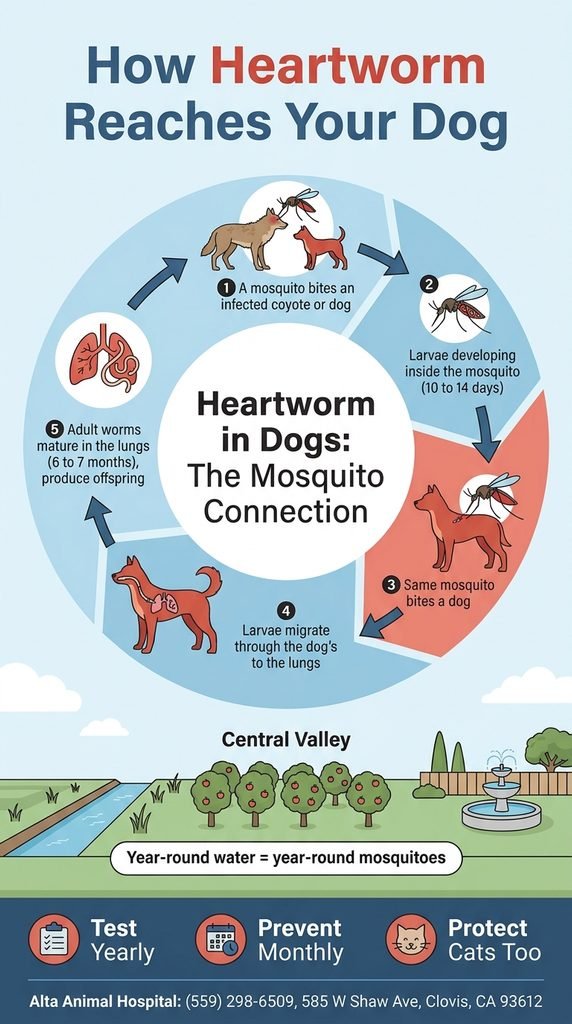
Heartworm can’t pass directly from dog to dog. Every infection needs a mosquito in the middle:
- A mosquito bites an infected animal, such as a dog or coyote, and swallows baby worms called microfilariae circulating in its blood.
- The larvae develop inside the mosquito over roughly 10 to 14 days in warm weather, becoming infective third-stage larvae (L3).
- The mosquito bites your dog and deposits those larvae on the skin, where they enter through the bite wound.
- Larvae migrate through tissue for a couple of months and reach the lung arteries as young adults.
- Worms mature in about 6 to 7 months and begin producing microfilariae, ready for the next mosquito.
That 6 to 7 month gap is why a heartworm test can come back negative even when a dog was infected last spring. Tests detect adult worms, not new larvae.
Why Heartworm Matters in Clovis and the Central Valley
The Central Valley doesn’t fit the old picture of heartworm country, but local conditions keep the risk real.
Irrigation Keeps Mosquitoes Busy Longer
Clovis sits in one of the most heavily irrigated farming regions in the country, surrounded by canals, orchards, ponding basins and lawns watered all summer. A study on irrigation and mosquito populations in California found that irrigation raised the abundance of Culex tarsalis and Culex pipiens mosquitoes 17 to 21 times and made their numbers far less seasonal. Research from the north San Joaquin Valley points to those same Culex species as central players in local dog heartworm transmission.
Add mild valley winters and backyard sources like fountains, pool covers and plant saucers, and there’s rarely a month when you can say the risk is zero. The same warm stretch that drives flea season in California also keeps mosquitoes active well into fall.
Heartworm Is Spreading in California
The American Heartworm Society runs a national incidence survey every three years. Its latest survey, based on 2025 testing data, flagged parts of California among the regions where heartworm cases are showing up more often than in the past. Dogs adopted or relocated from high-risk states add to the pool of infected animals, and wild coyotes keep the parasite circulating even when local dog numbers are low.
You can check current local risk on the CAPC pet parasite forecast, which predicts heartworm test positivity by county.
Symptoms of Heartworm in Dogs
Many dogs show nothing at all in the early months. When signs appear, they usually follow a pattern.
Early Stage Signs
- No symptoms, or an occasional mild cough
- Slightly less stamina on long walks or hot days
Moderate to Severe Signs
- A persistent cough that doesn’t clear up
- Tiring after mild activity, lagging behind or lying down mid-walk
- Weight loss and reduced appetite
- Faster or labored breathing
- A swollen belly from fluid buildup as the heart struggles
Caval Syndrome: A True Emergency
With a heavy worm burden, worms can back up into the right side of the heart and block blood flow. Dogs may suddenly collapse, have pale gums, breathe with difficulty or pass dark, coffee-colored urine. Caval syndrome requires surgical worm removal, and many dogs don’t survive it. If you see these signs, read our guide on when to take dog to emergency vet and get help right away.
| Stage | What You Might Notice | What It Means |
|---|---|---|
| Early | Nothing, or rare cough | Worms present, lung damage starting |
| Moderate | Ongoing cough, tires easily | Clear changes on chest X-rays |
| Severe | Labored breathing, weight loss, swollen belly | Heart and lung damage, possible heart failure |
| Caval syndrome | Collapse, pale gums, dark urine | Life-threatening blockage, emergency surgery |
A dog with a new cough that lasts more than a few days should be seen. If you can’t wait for a routine visit, look for same day vet appointments near me so the cough gets checked before it progresses.
Heartworm Testing Schedule for Dogs
The American Heartworm Society recommends yearly screening for all dogs over 7 months old, using both an antigen test and a microfilaria test. Testing still matters for dogs already on prevention, because doses get missed, chews get spit out and no product is perfect. Our in-house lab testing lets us run a heartworm screen during the same visit.
| Your Dog’s Situation | Recommended Testing |
|---|---|
| Puppy under 7 months | Start prevention by 8 weeks; first test about 6 months later, again 6 months after that, then yearly |
| Adult starting prevention for the first time | Test before starting, retest 6 months later, then yearly |
| Missed doses or switched products | Test promptly and again in 6 months |
| Adopted or relocated from another state | Test at the first visit and again 6 months later |
| Healthy adult on year-round prevention | Test once a year |
If you’re adding a new puppy to the family, heartworm prevention should start alongside the first round of puppy vaccines.
Heartworm Prevention for Dogs: Comparing Your Options
Every FDA-approved heartworm preventive belongs to one drug family called macrocyclic lactones, which includes ivermectin, milbemycin oxime, moxidectin and selamectin. They work by killing larvae picked up over the previous weeks, before those larvae can grow into adults. That’s why consistency matters more than which product you pick.
Monthly Oral Chewables
The most common form of monthly parasite prevention for dogs. Many chewables also control intestinal worms such as roundworms and hookworms, and some combine flea protection in the same dose. The main risk is human error: a forgotten dose, or a dog that quietly spits the chew out behind the couch.
Monthly Topicals
Applied to the skin between the shoulder blades. A good fit for dogs that refuse chews or have food sensitivities. Some topicals also cover fleas and certain intestinal parasites. Bathing and swimming rules vary by product, so follow the label closely.
Long-Acting Injectable
A moxidectin injection given by your veterinarian every 6 or 12 months, depending on the product. This removes the monthly reminder entirely, and the clinic tracks when the next dose is due. It covers heartworm only, so your dog may still need separate flea, tick and intestinal parasite control.
Comparing Parasite Prevention Medication for Dogs
| Feature | Monthly Chewable | Monthly Topical | Injectable |
|---|---|---|---|
| How often | Every 30 days | Every 30 days | Every 6 or 12 months |
| Given by | Owner at home | Owner at home | Veterinarian |
| Intestinal worm coverage | Often included | Some products | Not included |
| Flea coverage | Some combination products | Some products | Not included |
| Biggest risk | Missed or spit-out doses | Washing off, missed doses | Forgetting the renewal visit |
| Best for | Dogs that take treats easily | Picky eaters, sensitive stomachs | Busy households, inconsistent routines |
Your vet will recommend a product based on your dog’s weight, age, health history, lifestyle and other parasite risks. A full approach to pet parasite prevention usually pairs heartworm protection with flea, tick and intestinal worm control.
Why Year-Round Beats Seasonal
The American Heartworm Society and the Companion Animal Parasite Council both recommend giving prevention all 12 months. In the Central Valley, irrigation and warm stretches make “mosquito season” hard to define, and the monthly habit is easier to keep than a stop-and-start schedule. Many monthly products also clear intestinal parasites that can spread to people, which is a benefit you lose when you skip winter doses.
Extra Steps Around Your Home
- Empty standing water weekly from buckets, saucers, kiddie pools and tarps
- Keep pool covers drained and gutters clear
- Limit evening and dusk walks near canals and ponding basins during warm months, when Culex mosquitoes bite most
- Ask your vet whether a mosquito-repelling product makes sense for your dog
Treatment If Your Dog Tests Positive
A positive result is serious, but most dogs treated early go on to live full lives. Treatment follows the American Heartworm Society protocol and takes several months.
Confirmation and Staging
A positive screen is confirmed with a second test. Your vet then stages the disease with bloodwork, chest X-rays and sometimes an echocardiogram to see how much damage the worms have caused. Staging decides how carefully the treatment needs to move.
Preparing the Dog for Treatment
Before any worms are killed, your dog starts a heartworm preventive to stop new infections and clear baby worms, plus a 28-day course of the antibiotic doxycycline. Doxycycline targets Wolbachia, a bacterium living inside heartworms, which weakens the worms and reduces inflammation when they die.
The Three-Injection Protocol
About two months after diagnosis, your dog receives the first injection of melarsomine, the only FDA-approved drug that kills adult heartworms in dogs. A month later come two more injections, 24 hours apart. Published data show this three-dose approach kills around 99 percent of adult worms with fewer complications than shorter protocols.
Exercise Restriction and Retesting
This is the hardest part for owners. As worms die, fragments lodge in the lungs, and exercise raises the risk of dangerous blockages. Strict rest runs from diagnosis until at least 6 to 8 weeks after the final injection. That means leash-only bathroom breaks, no running, no jumping and no rough play. Nine months after the last injection, your dog is retested to confirm the worms are gone.
Prevention vs. Treatment at a Glance
| Prevention | Treatment | |
|---|---|---|
| Time involved | One dose a month or one injection a year | Five months or more |
| Activity limits | None | Strict rest for months |
| Vet visits | Routine checkups | Staging, multiple injections, follow-ups |
| Risk to the dog | Very low | Real risk of lung complications |
| Lasting damage | None | Some heart and lung changes may remain |
Why Cats Get Heartworm Too
Cats aren’t a natural host, so most larvae die before reaching adulthood. That sounds like good news, but it isn’t. When immature worms die in a cat’s lungs, they trigger intense inflammation called heartworm-associated respiratory disease, or HARD. Signs often look like asthma: coughing, wheezing, fast breathing, vomiting unrelated to meals and weight loss. In some cats, the first and only sign is sudden collapse or death, sometimes from just one or two worms.
There’s no approved drug to kill adult heartworms in cats. Melarsomine, the treatment used in dogs, is toxic to them. Care is limited to managing symptoms, which makes prevention the only real protection. Indoor cats aren’t exempt, because mosquitoes get through screen doors and open windows. Monthly topical and oral preventives for cats are widely available, and the American Heartworm Society now recommends routine annual screening for cats as well.
Case Study: What Testing Found in Fresno and Madera County Dogs
Local data shows heartworm is already here. In a study of dogs in Fresno and Madera Counties, researchers collected blood from 519 dogs at seven sites between April and July 2009 and screened them for heartworm antigen. Eighteen dogs tested positive, an overall rate of 3.47 percent. Fresno County came in at 3.5 percent and Madera County at 3.8 percent. The researchers also found that heartworm rates differed between foothill and valley habitats, which matters for Clovis since the city sits right where the valley floor meets the Sierra foothills.
Roughly 1 in 29 dogs testing positive may sound small, but every infected dog acts as a source for local mosquitoes. And this data predates the spread of new mosquito species and the rise in dogs relocated from high-risk states.
The takeaway: Fresno County dogs are being infected locally, and annual testing is how infections get caught while they’re still treatable.
Heartworm by the Numbers
| Finding | Source |
|---|---|
| 3.5% of sampled Fresno County dogs tested positive | Miller and Crosbie, Fresno and Madera County study |
| Irrigation increased Culex mosquito abundance 17 to 21 times | California irrigation and mosquito study (NSF) |
| Adult heartworms live 5 to 7 years in dogs and 2 to 3 years in cats | Veterinary parasitology references |
| Three-dose melarsomine kills about 99% of adult worms | AHS-based treatment data |
| Parts of California flagged as areas of increasing cases | American Heartworm Society 2025 incidence survey |
Heartworm Prevention and Testing at Alta Animal Hospital in Clovis
If you’re searching for parasite prevention for dogs in Clovis, our team keeps it simple. We run the heartworm test, review your dog’s lifestyle and other parasite risks, and help you choose the prevention format that fits your household. If you’ve been searching for parasite prevention near me, we can set up a plan that covers heartworm, fleas, ticks and intestinal worms together.
Heartworm screening fits naturally into an adult pet wellness exam, so one yearly visit covers the test, the physical exam and a prevention refill. To get started, book with a dog vet near me, call (559) 298-6509 or visit us at 585 W Shaw Ave, Clovis, CA 93612.
One missed dose costs nothing until the wrong mosquito finds your dog. Test every year, protect every month, and heartworm never gets the chance to start.
Frequently Asked Questions
-
Do dogs in Clovis really need year-round heartworm prevention?
Yes. Irrigation, ponding basins, backyard water and mild winters keep mosquitoes active for much of the year in the Central Valley, and local studies have found infected dogs in Fresno County. The American Heartworm Society recommends prevention all 12 months for every dog. Year-round dosing also builds a habit that’s easier to keep, and many monthly products control intestinal parasites at the same time, so skipping winter doses gives up more than heartworm protection alone.
-
What are the first signs of heartworm in dogs?
Most dogs show no signs early on, which is why yearly testing matters. When symptoms appear, the first ones are usually a mild, persistent cough and less energy on walks or in hot weather. As the disease advances, dogs may lose weight, breathe faster, tire after light activity or develop a swollen belly. Sudden collapse with pale gums or dark urine is an emergency. Any cough lasting more than a few days deserves a vet visit.
-
How often should my dog be tested for heartworm?
The American Heartworm Society recommends a heartworm test every year for all dogs over 7 months old, even those on year-round prevention. Puppies started on prevention before 7 months should be tested about 6 months after starting, again 6 months later, then yearly. Adult dogs starting prevention for the first time, dogs that missed doses and dogs that switched products should be tested right away and again 6 months later to catch infections still developing.
-
Which is better, monthly chewables or the heartworm injection?
Neither is better for every dog. Monthly chewables often cover intestinal worms and sometimes fleas, but they depend on you remembering each dose and your dog actually swallowing it. The injection lasts 6 or 12 months and is given at the clinic, which removes the risk of missed doses, but it covers heartworm only. Your veterinarian will weigh your dog’s health, lifestyle, other parasite risks and your routine before recommending a format.
-
Can my dog get heartworm from another dog?
No. Heartworm doesn’t spread through contact, shared bowls, play or saliva. Every infection requires a mosquito. The mosquito picks up baby worms from an infected animal, the larvae develop inside it for about two weeks, and then it passes them on when it bites another dog. That said, an untreated infected dog in your neighborhood does raise the local risk, because it becomes a source for mosquitoes to pick up and spread the parasite.
-
Can heartworm in dogs be cured?
Yes, in most cases. The American Heartworm Society protocol combines a preventive, a month of doxycycline and three melarsomine injections over several months, followed by strict exercise restriction. Dogs are retested nine months after the final injection to confirm success. Treatment is safest and most effective when the disease is caught early, before major heart and lung damage. Some lung and heart changes in advanced cases may remain, which is why prevention is far easier on your dog.
-
Do indoor cats need heartworm prevention?
Yes. Mosquitoes easily get inside through doors, windows and torn screens, and indoor cats have been diagnosed with heartworm. Cats often show asthma-like signs such as coughing and wheezing, and some show no warning before sudden collapse. Unlike dogs, cats have no approved treatment to kill adult heartworms, so prevention is the only reliable protection. Monthly topical and oral preventives for cats are safe, simple to give and can be added to their yearly wellness visit.