
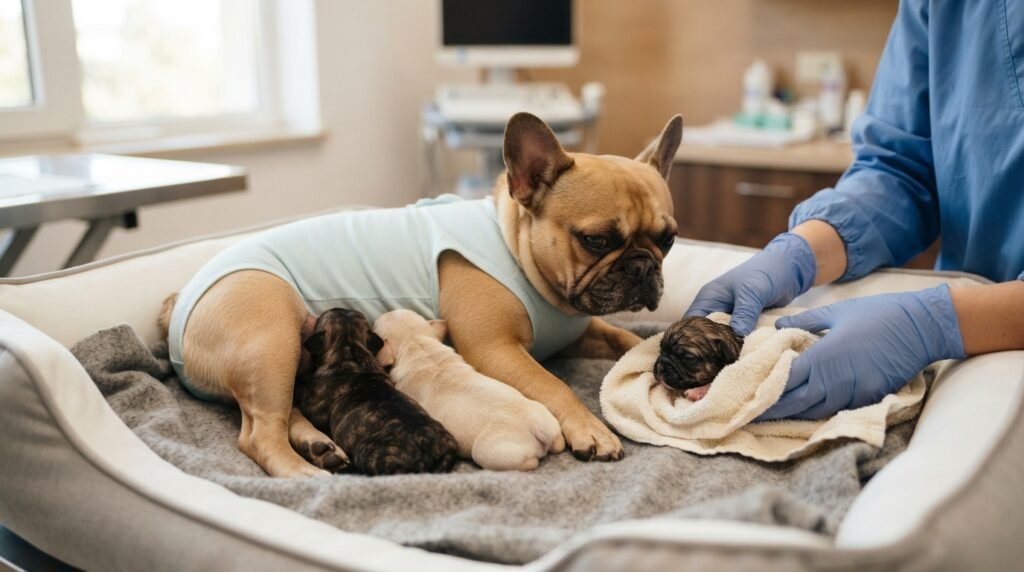
Most dogs deliver their puppies without help, but some simply can’t, and the hours spent waiting to find out can decide how things turn out for mom and the litter. A dog C-section in Clovis, CA is the surgery used to deliver puppies through the abdomen when natural birth stalls or isn’t safe to attempt. Whether your dog is due in a few weeks or is straining in the whelping box right now and you’re searching for a vet near me, this guide walks through the signs that mean she needs help, how planned and emergency C-sections for dogs differ, what actually happens in surgery, and how to care for her and the puppies once you’re home.
What Is a C-Section for Dogs?
A cesarean section is the surgical delivery of puppies through an incision in the belly and uterus. Each puppy is removed one at a time and passed to a team whose only job is to get it breathing and warm, then the uterus and abdomen are closed. The procedure usually takes around an hour, longer with big litters or an added spay.
There are two ways a dog ends up on the surgery table:
- Elective (planned) C-section: scheduled ahead because the breed, her history, or the puppy count makes natural birth risky.
- Emergency C-section: performed after labor has started and gone wrong, a condition called dystocia.
The surgery is similar. The circumstances around it are not, and that affects outcomes for mom and puppies.
Signs a Dog Needs a C-Section
Dystocia in dogs simply means a difficult birth. To spot it, you first need to know what normal labor looks like.
What Normal Labor Looks Like
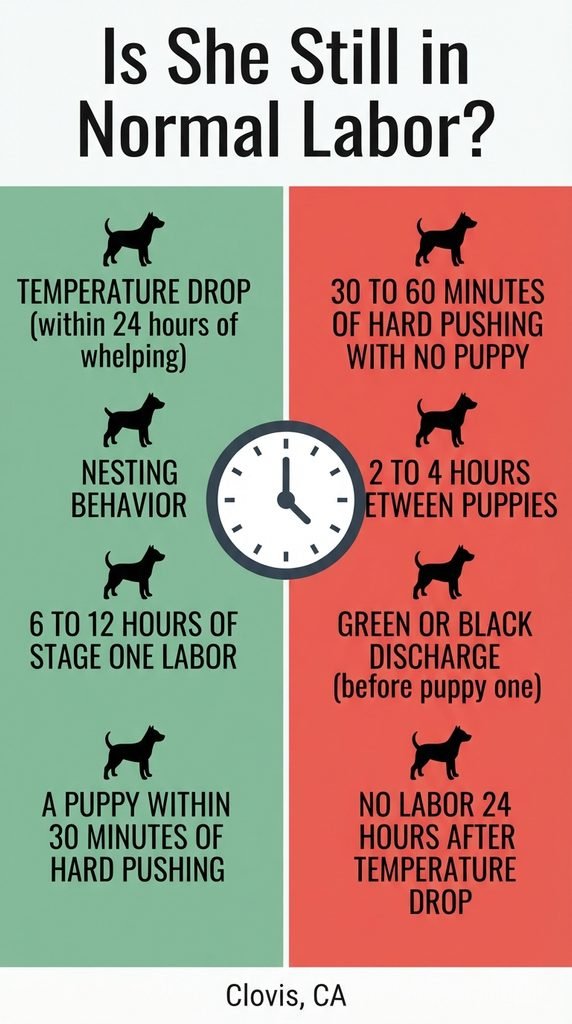
According to the Cornell Riney Canine Health Center, stage one labor usually starts 6 to 12 hours before delivery but can last 24 to 36 hours. Expect nesting, panting, shivering, refusing food, and a rectal temperature drop, often below 99°F, within about 24 hours of delivery.
Stage two is active pushing, and a puppy normally arrives within about 30 minutes of strong contractions. Stage three is the placenta. In dogs these two stages alternate, so two puppies followed by two placentas is common, and rest breaks between puppies are normal.
Dystocia Warning Signs
These are the signs that separate a slow labor from one that needs a veterinarian.
| What You See | What It Often Means | What to Do |
|---|---|---|
| Strong, steady contractions for 30 to 60 minutes with no puppy | A puppy is stuck or positioned wrong | Call the vet now |
| More than 2 to 4 hours between puppies when more are expected | The uterus is tiring (uterine inertia) | Call the vet now |
| Green or black discharge before the first puppy | The placenta has separated and a puppy is losing its oxygen supply | Go in immediately |
| Temperature dropped but no labor within 24 hours | Labor failed to start (primary inertia) | Call the vet now |
| Weak, on-and-off straining for over 2 hours | Labor is stalling | Call the vet now |
| A puppy visible at the vulva and not moving | Obstruction | Go in immediately |
| Heavy bright red bleeding, collapse, or extreme weakness | Mom is in danger | Go in immediately |
| Pregnancy running well past the due date | Possible fetal death or inertia | Call the vet now |
One honest note: green discharge is normal after the first puppy is born. Before the first puppy, it is a red flag.
If any of these happen when we’re closed, don’t wait for morning. Head to the nearest 24-hour emergency hospital in the Fresno area, then follow up with us. During open hours, our emergency vet near me service can see a laboring dog the same day. For a broader look at urgent problems, our guide on choosing an emergency vet Clovis pet owners can rely on covers what to bring and what to expect.
Breeds at Higher Risk for Dystocia
Some dogs need help far more often than others. A UK Kennel Club and BSAVA survey of pedigree litters found that, in Boston terriers, bulldogs, and French bulldogs, more than 80 percent of litters were delivered by C-section (Evans and Adams, Journal of Small Animal Practice).
| Breed | Litters Born by C-Section |
|---|---|
| Boston Terrier | 92.3% |
| Bulldog | 86.1% |
| French Bulldog | 81.3% |
| Mastiff | 64.6% |
| Scottish Terrier | 59.8% |
| Miniature Bull Terrier | 52.4% |
| Pekingese | 43.8% |
Later research from the Royal Veterinary College VetCompass program found French bulldogs were 15.9 times more likely to have dystocia than crossbred dogs, with Boston terriers at 12.9 times, pugs at 11.3 times, and Chihuahuas at 10.4 times.
Flat-faced breeds pair large heads and broad shoulders with a narrow pelvis, so puppies often can’t pass through, and their airways make anesthesia planning more involved. First-time and older mothers, dogs carrying only one or two puppies (sometimes too few to trigger labor), and very large litters also raise the risk.
Elective vs Emergency C-Section for Dogs
If your dog belongs to a high-risk breed or has needed a C-section before, an elective C-section is usually the safer path. Here’s how the two compare.
| Factor | Elective C-Section | Emergency C-Section |
|---|---|---|
| Timing | Scheduled around the confirmed due date | Whenever labor goes wrong, often at night |
| Mom’s condition | Rested, hydrated, not exhausted | Often tired, dehydrated, or in pain from hours of labor |
| Puppies’ condition | Not stressed by prolonged labor | May be oxygen-deprived from a stalled delivery |
| Pre-op workup | Bloodwork and X-rays done days ahead | Done quickly, sometimes in minutes |
| Staffing | Full resuscitation team arranged in advance | Team assembled under time pressure |
| Overall cost tendency | Usually lower, with fewer added treatments | Usually higher, with stabilization and extra care |
Emergency C-sections still go well in most cases. The difference is margin: a planned surgery removes the guesswork and the clock.
Planning an Elective C-Section: Progesterone Timing and X-Ray Puppy Count
The biggest risk in a planned C-section is operating too early, since premature puppies may have lungs that aren’t ready. A due date counted from the breeding date can be off by a week, so planning relies on harder data:
- Progesterone testing during heat pinpoints ovulation. Cornell puts the due date at about 63 days from ovulation, give or take one to two days.
- An X-ray around day 55 gives a reliable puppy count once skeletons are mineralized and shows head size against mom’s pelvis. The count also tells you when every puppy is out.
- Pre-surgical bloodwork checks organ function and clotting. Our in-house X-rays and bloodwork return lab results in about 30 minutes.
- Final timing is set from the ovulation date, often confirmed by a falling progesterone level or temperature drop.
If you’re planning a litter, book a pre-breeding consultation before her heat cycle so testing starts on time.
What Happens During Dog C-Section Surgery
Before Anesthesia
Mom gets an IV catheter and fluids. If she’s calm, her belly is clipped and scrubbed before she goes under while she breathes oxygen through a mask. Every minute saved here means less anesthetic reaching the puppies.
Anesthesia Chosen to Protect the Puppies
Most drugs that reach mom cross the placenta, so the plan uses short-acting drugs that clear quickly: a fast induction agent, inhaled anesthetic gas, and a local numbing block along the incision. Stronger pain medications are often held until the last puppy is out, or reversible drugs are used.
Delivering the Puppies
The surgeon brings the uterus out, opens it, and eases each puppy out. The sac is opened, the cord clamped, and the puppy handed off within seconds. Both uterine horns and the birth canal are checked so no puppy is left behind.
The Neonatal Resuscitation Team
For every puppy, the second team:
- Clears fluid from the mouth and nose with gentle suction
- Rubs the puppy briskly with warm towels to stimulate breathing
- Provides oxygen and reversal drops under the tongue if needed
- Checks for defects such as cleft palate
- Keeps the puppy in a warmed box until mom is awake
Closing and Waking Up
The uterus, abdominal wall, and skin are closed in layers, often with buried absorbable stitches that nursing puppies can’t pull at. Our veterinary surgery team monitors heart rate, oxygen, and temperature throughout, followed by warm recovery care. Puppies join mom once she can lie safely beside them.
Option to Spay During the C-Section
If you don’t plan to breed her again, a spay can be done at the same time. Decide before surgery day.
- Benefits: one anesthesia instead of two, no future pregnancies or pyometra, and milk production generally continues.
- Trade-offs: longer surgery, and the pregnant uterus has large blood vessels, so bleeding risk is higher.
If you’d rather wait, our spay surgery near me service can schedule it once the litter is weaned. Our spay and neuter guide for Clovis owners explains timing and recovery.
Dog C-Section Cost: What Affects the Final Bill
How much a C-section for a dog costs varies widely. The main factors:
- Elective or emergency: emergencies often need stabilization, extra fluids, and more monitoring.
- Size and litter: bigger dogs need more drugs, and more puppies mean more surgery and resuscitation time.
- Testing: progesterone tests, X-rays, and bloodwork.
- Extras: an added spay, an overnight stay, care for weak puppies, and take-home medications.
A planned C-section lets you get an estimate early. If cost is a concern, ask about our flexible payment options before the due date.
Dog C-Section Recovery at Home: Caring for Mom
Dog C-section recovery is unusual because your patient has a fresh abdominal incision and a litter to feed. Most incisions heal in 10 to 14 days. Our article on the typical recovery timeline for different dog surgeries shows how this compares with other procedures.
The First 24 Hours
She’ll be groggy for several hours, and some mothers don’t recognize their puppies right away. Sit with her for the first nursing sessions, guide puppies to the nipples, and make sure she doesn’t lie on anyone. Offer small amounts of water and food at first, in a quiet, low-traffic whelping area.
Incision Care
- Check the incision twice daily. Mild redness and slight swelling are normal.
- Call us about discharge, gaping, heat, or growing swelling.
- No baths, and leash walks only for about two weeks.
- Change bedding often to keep it clean and dry.
Nursing With Stitches
The incision sits between her rows of nipples, which is why buried stitches help. Check her mammary glands daily. A gland that is hot, hard, or discolored can mean mastitis.
Pain Medication Safe for Nursing
Her take-home pain medication is chosen to be compatible with nursing. Give it exactly as prescribed. Never give ibuprofen, naproxen, or acetaminophen, which are toxic to dogs. These signs your dog is in pain can help you judge her comfort.
Normal Discharge vs Warning Signs
A reddish-brown discharge (lochia) is normal for a few weeks and slowly tapers off. Call us right away if you notice:
- A foul smell or pus-like discharge
- Fever, lethargy, or refusing food for more than a day
- Restlessness, panting, trembling, muscle stiffness, or wobbling (signs of eclampsia, a dangerous drop in blood calcium)
- Rejecting or ignoring the puppies
Newborn Puppy Care: The First 72 Hours
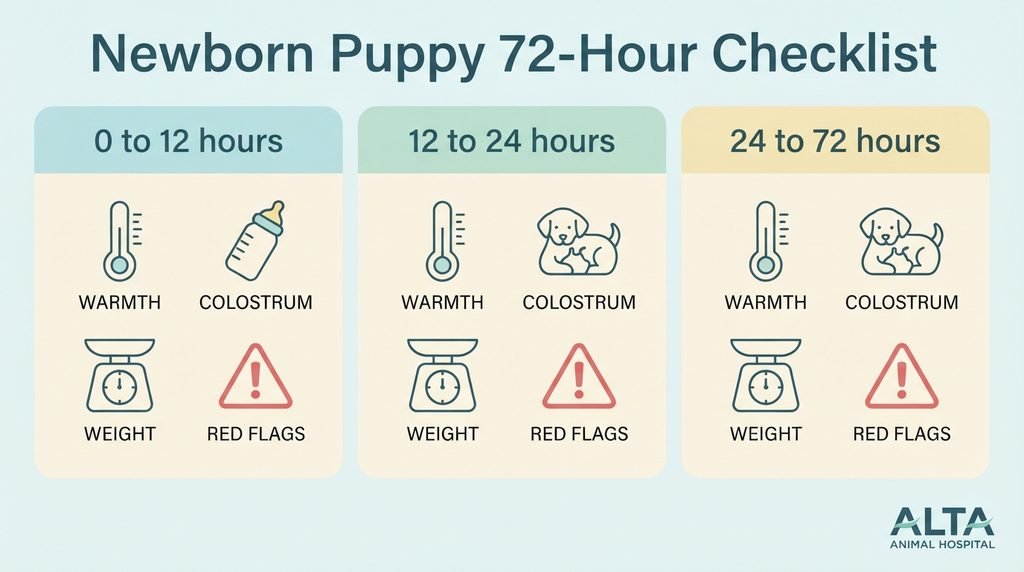
Newborn puppies can’t control their body temperature, can’t see or hear, and depend on mom for everything. After a C-section they need a bit of extra watching.
| Time Frame | Priorities | Warning Signs |
|---|---|---|
| Hours 0 to 12 | First nursing for colostrum (the antibody-rich first milk), warmth, supervised contact with mom | Weak suckle, cold to the touch, bluish gums |
| Hours 12 to 24 | Nursing every 1 to 2 hours, first weigh-in on a gram scale | Constant crying, milk bubbling from the nose |
| Hours 24 to 72 | Steady weight gain after a small first-day dip, mom stimulating them to urinate and defecate | Weight loss on day 2 or 3, bloated belly, isolating from littermates |
- Keep the whelping box around 85 to 90°F for the first several days, with a cooler corner.
- Weigh each puppy daily at the same time. Weight is the earliest warning sign you’ll get.
- Make sure smaller puppies aren’t pushed off the nipples.
Later, plan their first exam and puppy vaccines on the standard schedule.
Case Example: How a Planned C-Section Unfolds for a High-Risk Breed
The timeline below shows how a typical elective C-section is planned for a brachycephalic breed such as a French bulldog. It’s a composite built from standard planning steps, not a specific patient.
| Stage | What Happens | Why It Matters |
|---|---|---|
| During heat | Serial progesterone blood tests | Pinpoints ovulation day |
| Day 25 to 30 | Ultrasound | Confirms pregnancy and heartbeats |
| Day 55 | Abdominal X-ray | Counts puppies, checks head size against the pelvis |
| Day 58 to 60 | Pre-surgical bloodwork and airway check | Confirms she’s fit for anesthesia |
| Day 61 to 63 | C-section when timing and progesterone align | Puppies are mature, mom is rested |
| Days 1 to 3 at home | Supervised nursing, daily weigh-ins | Catches weak puppies early |
| Day 10 to 14 | Incision recheck | Confirms mom is healing well |
The pattern is the point. Each step removes a piece of guesswork, so surgery day becomes routine rather than a 2 a.m. scramble.
Finding a Dog C-Section Near Me in Clovis, CA
If you’ve been searching for a dog C-section near me, look for a hospital that can handle the full chain: progesterone timing, in-house X-rays and bloodwork, surgery with anesthesia monitoring, and a team ready to resuscitate puppies. Alta Animal Hospital at 585 W Shaw Ave, Clovis, CA 93612 serves families across Clovis and the greater Fresno area. Call us at (559) 298-6509 to plan ahead for a high-risk pregnancy or to ask whether your dog’s labor needs attention now.
A C-section is never anyone’s first choice, but with good timing, the right anesthesia, and a prepared team, most moms and puppies go home healthy and recover well.
Frequently Asked Questions About Dog C-Sections
-
How much is a C-section for a dog in Clovis?
The cost of a dog C-section depends on whether it’s planned or an emergency, your dog’s size, how many puppies she’s carrying, which pre-surgical tests are needed, and whether a spay is added. Hospital stays and care for weak puppies also affect the total. Planned C-sections generally cost less because mom and puppies arrive stable. Ask for an estimate at your pre-surgery visit so you know what to expect well before the due date.
-
How long is dog C-section recovery?
Most dogs are up and nursing within a few hours of surgery, but full dog C-section recovery takes about 10 to 14 days while the incision heals. During that time, limit her to leash walks for bathroom breaks, skip baths, and check the incision twice daily. Vaginal discharge can continue for a few weeks and should slowly lighten. A recheck visit near the two-week mark confirms she’s healing properly and ready for normal activity.
-
Can my dog nurse her puppies after a C-section?
Yes. Most mothers nurse normally after a C-section, and early nursing gives puppies colostrum, the antibody-rich first milk. Anesthetic drugs are chosen to clear quickly, and take-home pain medications are selected to be safe for nursing. Supervise the first few sessions since she may still be drowsy. Buried stitches help keep the incision comfortable while the puppies feed, and you should check her mammary glands daily for heat or hardness.
-
Should I spay my dog during her C-section?
Spaying during a C-section avoids a second anesthesia and prevents future pregnancies and pyometra. The trade-off is a longer surgery and a higher bleeding risk, since the pregnant uterus has large blood vessels. Milk production usually continues afterward. If you don’t plan to breed her again, discuss it with your veterinarian before surgery day. Some owners prefer to wait until the puppies are weaned and schedule a routine spay then.
-
Can a dog have puppies naturally after a C-section?
Some dogs deliver naturally after a previous C-section, especially if the first surgery was due to a one-time issue like a single oversized puppy or a malpositioned fetus. Dogs whose C-section was caused by body shape, such as a narrow pelvis in brachycephalic breeds, usually need another. Your veterinarian will review her history, breed, and X-ray findings to recommend whether to attempt natural delivery or schedule an elective C-section.
-
What are the signs a dog needs an emergency C-section?
Call a vet immediately if your dog has strong contractions for 30 to 60 minutes without delivering a puppy, goes more than 2 to 4 hours between puppies, or passes green or black discharge before the first puppy. Other warning signs include no labor within 24 hours of a temperature drop, a puppy stuck in the birth canal, heavy bleeding, or collapse. Any of these can mean she needs surgery quickly.