
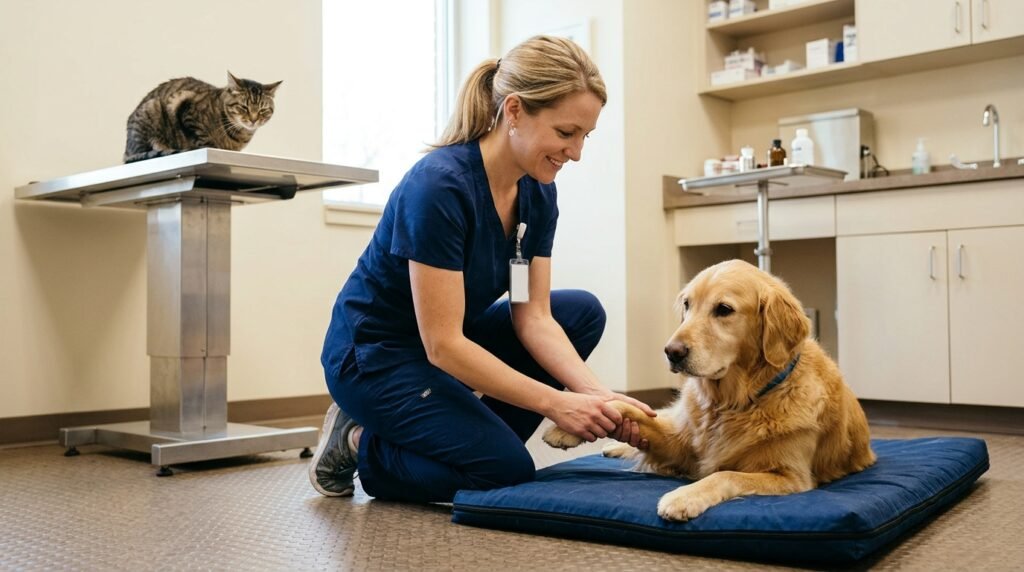
Your dog skipped breakfast and won’t take the stairs. Your cat has spent two days under the guest bed. Neither of them can tell you what hurts, so learning the signs your dog or cat is in pain is the closest thing you have to a translator. This guide from the team at Alta Animal Hospital in Clovis, CA covers 12 pain signals, how cats and dogs show them differently, how vets actually score pain, and how to tell when you can watch things at home and when to stop searching for a vet near me and pick up the phone.
Why Pain Is So Easy to Miss in Dogs and Cats
Pets are wired to hide weakness. In the wild, an animal that looks hurt becomes a target, and that instinct didn’t disappear when dogs and cats moved onto our couches. The AAHA 2022 Pain Management Guidelines for Dogs and Cats point out that owners usually watch for sudden, obvious pain, like a yelp or a limp, and miss the slow behavior changes that point to chronic pain.
That gap matters. Pain that goes unnoticed for months changes how a pet moves, eats, sleeps and gets along with the family. It also tends to get harder to manage the longer it runs.
How Cats Hide Pain
Cats sit in an awkward spot on the food chain. They hunt, but they also get hunted, so they’re experts at looking fine. In an exam room, a stressed cat often freezes and looks perfectly normal, which is exactly why vets lean on what owners see at home.
Feline pain signs are usually subtractive. The cat stops doing things. It stops jumping onto the counter, stops grooming the middle of its back, stops meeting you at the door. And purring isn’t proof of comfort. Cats purr when they’re relaxed, but they also purr when they’re scared, sick or hurting.
How Dogs Show and Mask Pain
Dogs are more expressive, but they’re also eager to please. A dog with a sore knee will still chase a ball on pure adrenaline, then limp for the rest of the evening. Dog pain signs tend to be additive: panting, whining, licking one spot, guarding a body part, pacing at night.
Breed and personality play a role too. Labradors and many working breeds are famously stoic, while some small breeds vocalize at the first twinge. Know what’s normal for your dog so you can spot what isn’t.
Cats vs. Dogs: How Pain Usually Shows Up
| Pain Signal | Cats | Dogs |
|---|---|---|
| Typical first response | Hide, go still, withdraw | Vocalize, pant, cling or avoid contact |
| Movement | Stop jumping, use lower surfaces | Limp, stiff when rising, slow on walks |
| Grooming | Stop grooming or overgroom one patch | Lick or chew one spot repeatedly |
| Face | Squinting, ears flattened or rotated out, tense muzzle | Worried look, ears pinned back, furrowed brow |
| Breathing | Open-mouth breathing is an emergency | Panting at rest without heat or exercise |
| Appetite | Skips meals, drops food | Eats slowly, chews on one side |
| Bathroom habits | Urinates outside the box, strains | Accidents, posturing longer than usual |
| Reaction to touch | Hisses, swats or flinches | Growls, snaps or yelps at one spot |
Behavioral Signs Your Dog or Cat Is in Pain
Behavior changes are usually the first clue, and they’re the easiest to explain away. If something feels off for more than a day, take it seriously.
1. Hiding or Withdrawing From the Family
A cat that suddenly lives under the bed or in the closet is often telling you something. Dogs withdraw too, skipping their usual spot on the couch or leaving the room when the kids get loud. A pet that used to seek you out and now avoids contact deserves a closer look.
2. Changes in Appetite or Water Intake
Pain kills appetite. Dental pain, abdominal pain and nausea all show up as a pet walking up to the bowl, sniffing and leaving. For cats, going more than 24 hours without eating is a problem on its own, because cats can develop serious liver complications when they stop eating.
3. Restlessness or Trouble Getting Comfortable
Watch how your pet lies down. A dog that circles, lies down, gets up and circles again may be hurting. Pacing at night, sleeping in odd places and shifting positions constantly are all common. Some pets go the other way and sleep far more than normal, which is just as worth noting.
4. Irritability or Aggression When Touched
A gentle dog that growls when you touch its hip, or a cuddly cat that swats when you stroke its back, is usually protecting a sore spot. Cats with a bite wound often react this way before you ever see swelling, and that wound can turn into a painful cat abscess within a few days. Never punish this behavior. It’s communication, not attitude.
5. Unusual Vocalizing
Dogs whimper, whine, groan when lying down or yelp when they move a certain way. Cats may yowl, growl or hiss more than usual, especially when picked up. A cat crying in the litter box is a separate and urgent sign we cover below.
6. Changes in Grooming
Pets lick what hurts. A dog obsessively licking one wrist or knee may have joint pain or a wound under the fur. Cats show the opposite pattern too. An arthritic cat often can’t twist far enough to groom its lower back and hind end, so the coat there turns greasy, matted or flaky.
Physical Signs of Pain in Dogs and Cats
These signs are easier to see but still get missed, especially when they come on slowly. Many dog cat veterinary health symptoms in this group point to joint, belly or mouth pain.
7. Limping, Stiffness or Reluctance to Jump
A dog that’s slow to get up after a nap, lags behind on walks or hesitates at the car door may have joint pain. Cats rarely limp obviously. Instead, they stop jumping to high places or use a chair as a step on the way to the counter.
8. Changes in Posture
A hunched back, tucked belly or lowered head often signals abdominal or spinal pain. Some dogs with belly pain stretch into a “prayer position,” front legs down and rear end up, and hold it. A cat sitting hunched in a loaf with its head low and eyes half closed is often uncomfortable, not relaxed.
9. Facial Expression Changes
Pain changes the face. Look for squinting, ears pinned back or rotated outward, a tight muzzle and whiskers pulled forward or flattened. Dogs may look glazed or worried, with a furrowed brow. These expressions are the basis of the pain scales vets use, covered later in this guide.
10. Panting or Fast Breathing at Rest
A dog panting hard in a cool room, without exercise, can be in pain or distress. In cats, open-mouth breathing is never normal outside of intense play and should be treated as an emergency. Shallow, rapid breathing in either species can also point to chest or abdominal pain.
11. Litter Box and Bathroom Changes
Straining, urinating in small amounts, peeing outside the box or crying while trying to go are classic signs of urinary pain. In male cats, straining with little or no urine can mean a urethral blockage, which can become life-threatening within a day or two. Dogs may have accidents indoors or struggle to squat or lift a leg because of back or hip pain.
12. Drooling, Pawing at the Mouth or Dropping Food
Mouth pain is one of the most common hidden pain sources in both species. Watch for drooling, bad breath, chewing on one side, dropping kibble or pawing at the face. Broken teeth, gum disease and resorptive lesions in cats are all painful, and a pet dentist near me visit is the only way to see what’s going on below the gumline.
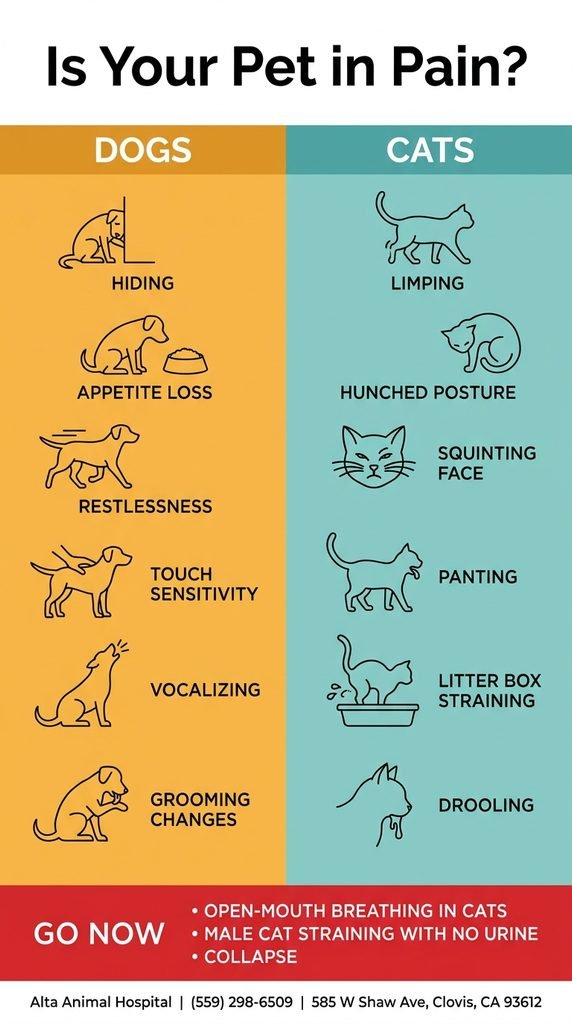
Urgent or Monitor? When to Take Your Cat or Dog to the Vet
Not every sign means a late-night drive. The tricky part is knowing which ones can wait for a regular appointment. Use the three tiers below as a starting point, and when you’re unsure, call.
Emergency Signs: Go Now
These are the signs to take a dog to the emergency vet, and the same applies to cats:
- Open-mouth breathing in a cat, or labored breathing in either species
- A male cat straining in the litter box with little or no urine
- Collapse, inability to stand or sudden paralysis of the back legs
- A swollen, hard belly with retching that brings nothing up (dogs)
- Crying out when touched along with pale gums or a racing heartbeat
- Trauma of any kind, even if your pet seems fine afterward
If you see any of these, contact an emergency vet Clovis pet owners can reach right away. Our full guide on when to take your cat to the emergency vet covers more cat emergency symptoms in detail.
Same-Day Signs: Call Today
A new limp that doesn’t improve within a few hours, refusing food for a full day, vomiting more than twice, a painful swelling or a pet that won’t settle all deserve a same-day exam. Look for an urgent care vet near me that can see your pet before a manageable problem becomes an emergency.
Signs You Can Monitor for 24 to 48 Hours
Mild stiffness after a long hike, a single skipped meal with normal energy, or slight hesitation on stairs can often be watched briefly. Keep notes, take short videos and limit activity. If things don’t clearly improve within two days, or anything gets worse, book a pet health checkup.
| Urgency Level | What You Might See | What to Do |
|---|---|---|
| Emergency | Breathing trouble, male cat unable to pee, collapse, bloated belly, trauma | Go to a vet immediately |
| Same day | New limp, no food for 24 hours, repeated vomiting, painful swelling | Call the clinic today |
| Monitor | Mild stiffness, one skipped meal, slight slowness with normal energy | Watch 24 to 48 hours, keep a log |
Pain Scoring Basics: How Vets Measure What Pets Can’t Say
Since pets can’t rate their pain from 1 to 10, veterinarians use validated pain scales that turn behavior and facial expression into numbers. The World Small Animal Veterinary Association encourages vets to treat pain as the fourth vital sign, checked alongside temperature, pulse and breathing.
The Feline Grimace Scale
Researchers at the Université de Montréal developed the Feline Grimace Scale to score acute pain from a cat’s face. It looks at five features: ear position, orbital tightening around the eyes, muzzle tension, whisker position and head position. Each is scored 0, 1 or 2, for a maximum of 10. Higher scores mean more pain, and the scale helps vets decide when a cat needs pain relief.
The Glasgow Composite Measure Pain Scale for Dogs
For dogs, many clinics use the short form of the Glasgow Composite Measure Pain Scale. It scores six categories: vocalizing, attention to the painful area, mobility, response to touch, demeanor and posture. The maximum is 24, and a score of 6 or higher is the recommended point to give pain relief.
A Simple At-Home Pain Log
You don’t need a formal scale to help your vet. Each day, rate these five areas from 0 (normal) to 3 (very changed):
- Appetite: eating normally, picky, or refusing
- Movement: jumping, stairs, getting up, walk length
- Mood: social, withdrawn, irritable
- Sleep: settled, restless, sleeping much more
- Bathroom: normal, straining, accidents
Add a short phone video of your pet walking, jumping or getting up. Thirty seconds of real-life footage often tells a vet more than a stressed pet on an exam table can.
Case Study: What Happened When Researchers Scored Cat Pain
The Feline Grimace Scale wasn’t built on guesswork. In the validation study published in Scientific Reports in 2019, researchers filmed 35 client-owned cats with painful medical conditions alongside 20 pain-free cats. The painful cats scored clearly higher. After those cats received pain relief, they were filmed again an hour later, and their scores dropped. The scale also matched another validated feline pain tool closely.
A second study shows how much goes unseen. Researchers reviewing X-rays of 100 cats over 12 years old, taken for reasons unrelated to lameness, found degenerative joint disease in 90 percent of them. Very few had ever been recorded as lame.
The takeaway for owners: cat pain is measurable and treatable, but it rarely announces itself. If your senior cat has slowed down, don’t assume it’s just age.
Pain in Pets by the Numbers
| Finding | Source |
|---|---|
| 90% of cats over 12 showed degenerative joint disease on X-rays | Hardie et al., JAVMA, 2002 |
| Most cats over 10 years old show signs of osteoarthritis pain | AAHA Pain Management Guidelines, 2022 |
| Around 20% of dogs over 1 year old are estimated to have osteoarthritis in North America | Published veterinary prevalence estimates |
| UK dogs over 12 were 54 times more likely to have osteoarthritis than dogs under 3 | Royal Veterinary College VetCompass study, 2018 |
| Feline Grimace Scale scores dropped after pain relief in painful cats | Evangelista et al., Scientific Reports, 2019 |
What Not to Do When You Suspect Pain
Good intentions can make things worse. Avoid these common mistakes:
- Don’t give human pain medication. Ibuprofen, naproxen and acetaminophen can cause stomach ulcers, kidney damage or liver failure in pets. Acetaminophen is especially dangerous for cats. The ASPCA lists common human medications among the top pet poison risks.
- Don’t share another pet’s prescription. Doses and drugs that are safe for one dog can be toxic for a cat or a smaller dog.
- Don’t push exercise to “work it out.” Rest is safer until a vet has found the cause.
- Don’t blame age alone. Slowing down is common in older pets, but pain is often the reason, and it’s treatable.
- Don’t wait on urinary straining. Especially in male cats, hours matter.
What to Expect at a Pain Exam at Alta Animal Hospital in Clovis
If you’re looking for a cat and dog vet in Clovis who takes pain seriously, here’s how a typical visit works at our hospital on W Shaw Ave.
Observation and History
We start by watching how your pet walks, sits and reacts before anyone touches them. We’ll ask about changes in appetite, sleep, behavior and bathroom habits, so bring your pain log and any videos.
Hands-On Exam and Diagnostics
Your veterinarian gently feels joints, the spine, the belly and the mouth to find the source of pain. When needed, in-house diagnostics like bloodwork, urinalysis and X-rays help confirm the cause without sending samples away and waiting days. Some injuries, like a torn knee ligament or a foreign object in the gut, may need veterinary surgery to truly fix the problem.
A Pain Plan Built for Your Pet
Pain care works best when it combines several approaches, such as pet-safe medication, weight management, joint support, home changes and follow-up checks. We reassess and adjust the plan as your pet responds, and routine visits like an annual pet checkup help catch new problems early.
Chronic Pain in Senior Dogs and Cats
Chronic pain is the type owners miss most often. AAHA identifies musculoskeletal pain, mainly osteoarthritis, as the most common form of chronic pain in dogs. In a large UK study of more than 455,000 dogs, those over 12 were 54 times more likely to have osteoarthritis than dogs under 3.
For cats, chronic pain usually looks like a quieter, less active pet. Smaller jumps, less play, more napping in low places and a scruffy lower back are easy to write off as getting older.
Signs worth bringing up during senior pet care visits include:
- Trouble with stairs, car rides or getting onto furniture
- Shorter walks or lagging behind
- Sleeping more and playing less
- Litter box accidents in cats, often from painful hips that make climbing in hard
- Irritability with other pets or children
Many senior pets get noticeably more active once their pain is managed. Owners often say they “got their old dog back.”
Book a Pain Check With Our Clovis Veterinary Team
Alta Animal Hospital has cared for Clovis pets since 1978. If you’ve noticed any of the signs in this guide, call us at (559) 298-6509 or visit us at 585 W Shaw Ave, Clovis, CA 93612. Bring your notes and videos, and we’ll help you figure out what’s going on.
Your pet can’t tell you where it hurts, but the way they move, eat and act always does. Paying attention is the first step toward relief.
Frequently Asked Questions
-
How can I tell if my cat is in pain if she seems normal?
Cats hide pain well, so look for things your cat has stopped doing rather than new behaviors. Skipping jumps to favorite high spots, grooming less along the back, hiding more, eating less or using the litter box differently are common clues. Squinting and flattened ears also matter. If you notice any of these for more than a day or two, schedule an exam. A short video of your cat at home helps your vet see what she hides in the clinic.
-
What are the signs to take a dog to the emergency vet?
Go immediately if your dog has trouble breathing, collapses, can’t stand, has a swollen hard belly with unproductive retching, or has pale gums with a racing heartbeat. Any trauma, such as being hit by a car or falling, also needs urgent care even if your dog seems fine. Crying out when touched, combined with weakness or vomiting, is another red flag. When in doubt, call your vet and describe exactly what you’re seeing.
-
When should I take my cat to the vet for emergency signs?
Cat emergency symptoms include open-mouth breathing, straining in the litter box with little or no urine, collapse, sudden back leg weakness, repeated vomiting and refusing all food for more than 24 hours. Male cats that strain to urinate are the most time-sensitive, because a urinary blockage can become fatal quickly. Hiding combined with any of these signs makes things more urgent, not less. Call right away instead of waiting to see if it passes.
-
Can I give my dog or cat human pain medicine?
No. Common human pain relievers like ibuprofen, naproxen and acetaminophen can cause stomach ulcers, kidney failure or liver damage in pets, even at small doses. Acetaminophen is especially toxic to cats. Veterinary pain medications are formulated and dosed for each species and body weight. If you think your pet is hurting, call your veterinarian before giving anything at home. If your pet has already swallowed a human medication, contact your vet or a pet poison hotline immediately.
-
Does purring or tail wagging mean my pet isn’t in pain?
Not always. Cats purr when content, but also when stressed, sick or hurting, and some purr more when they’re in pain. Dogs may wag their tails out of excitement or to greet you even while uncomfortable. These signals show emotion, not physical comfort. Look at the bigger picture instead: posture, appetite, movement, facial expression and how your pet reacts when a specific area is touched. Those signs give a much more reliable read on pain.
-
How often should my pet get a health checkup to catch hidden pain?
Most adult dogs and cats benefit from a wellness exam once a year. Senior pets, usually over 7 for dogs and over 10 for cats, often do better with exams every six months, because arthritis, dental disease and other painful conditions become more common with age. Regular visits let your vet compare joint mobility, weight and behavior over time, which makes slow changes much easier to spot before they turn into bigger problems.
-
Can a vet tell if my pet is in pain if they act fine at the clinic?
Yes, but your input matters a lot. Pets often hide pain in unfamiliar places, especially cats. Veterinarians use hands-on exams, facial expression scales, gait observation and diagnostics like X-rays or bloodwork to find painful areas. Your observations from home fill in the rest. Bring a list of changes you’ve noticed, along with short videos of your pet walking, jumping or eating. Together, these details give your vet a far clearer picture.