
The best age to spay or neuter is no longer a single number on a reminder card, and if you have asked a vet near me in Clovis about it lately, you may have heard answers ranging from four months to well past a year. That spread is not confusion. It reflects twenty years of research showing that breed size, sex, and species all change the math, and this guide walks through what those studies found for dogs, cats, and rabbits so you can make the call with your veterinarian instead of guessing.
What Is Spay Neuter Surgery, and Why Does Timing Matter?
Before getting into ages, it helps to be clear on terms, because people often use “spay” and “neuter” as if they mean the same thing.
Spay and Neuter Difference: A Plain Definition
Here is the spay and neuter difference definition in one line each:
- Spay: surgical removal of the ovaries, and usually the uterus, in a female animal. Vets call it an ovariohysterectomy or, when only the ovaries come out, an ovariectomy.
- Neuter: surgical removal of the testicles in a male animal, also called castration or orchiectomy.
Both procedures end the ability to reproduce and remove the main source of sex hormones. “Neuter” is also used loosely for either sex, which is why you will see “spay neuter” written as one phrase. If you want a deeper side-by-side on spay vs neuter, including anesthesia time and recovery differences, we cover that separately in our spay vs neuter guide.
Why Spay or Neuter a Dog, Cat, or Rabbit at All?
The short answer to why spay or neuter a dog (or any pet) comes down to three things:
- Population control. Shelters across California’s Central Valley still take in more animals than they can place.
- Disease prevention. Spaying removes the risk of pyometra, a life-threatening uterine infection, and ovarian and uterine cancers. Neutering removes the risk of testicular cancer.
- Behavior. Hormone-driven roaming, marking, and heat-cycle behavior usually drop after surgery.
Timing matters because sex hormones do more than drive reproduction. In growing animals, they help signal the growth plates in long bones to close. Remove them too early in certain dogs and the bones keep growing a little longer, which can change joint angles. That single fact sits at the center of the modern debate.
How the “Six Months for Everyone” Rule Changed
For decades, six months was the default answer for every puppy and kitten. Shelters then pushed the other way, adopting pediatric spay and neuter at 8 to 16 weeks so that no animal left the building intact. Both approaches were built mostly on population goals, not long-term health tracking.
That changed when researchers began comparing medical records of neutered and intact dogs over many years. The results showed that the risks and benefits are real on both sides, and they do not fall evenly across all dogs. A 10-pound Maltese and a 90-pound Labrador simply do not respond the same way to early surgery.
What the Research Shows for Dogs
Body Size Is the Biggest Variable
The most useful data for mixed-breed owners comes from a 2020 UC Davis study by Hart and colleagues, published in Frontiers in Veterinary Science. The team grouped mixed-breed dogs into five adult weight categories and tracked joint disorders (hip dysplasia, elbow dysplasia, and cranial cruciate ligament tears) by age at neutering.
| Adult Weight | Joint Risk if Neutered Before 12 Months | What the Data Showed |
|---|---|---|
| Under 22 lb (under 10 kg) | No significant increase | Both sexes, any age tested |
| 22 to 42 lb (10 to 19 kg) | No significant increase | Both sexes, any age tested |
| 44 to 64 lb (20 to 29 kg) | Increased | Females rose from 4% intact to 10 to 12% when spayed before 1 year |
| 66 to 86 lb (30 to 39 kg) | Increased | Males rose from 8% to 17% when neutered before 6 months |
| 88 lb and up (40+ kg) | Increased in males | Males rose from 9% to 28% when neutered before 6 months |
The same study found no significant rise in cancer rates for any weight group at any neuter age. For mixed breeds, the pattern is clear enough to act on: the bigger the expected adult dog, the stronger the case for waiting.
Breed-Specific Findings Matter for Purebreds
A companion paper from the same group looked at 35 breeds using 15 years of hospital records and published a breed-by-breed decision table. A few takeaways stand out:
- Most small breeds showed no added joint risk with early neutering, including Chihuahuas, Yorkshire Terriers, Shih Tzus, Pugs, Dachshunds, and Toy Poodles.
- Golden Retrievers were an outlier. Spayed females at any age showed cancer rates roughly two to four times higher than the 5% seen in intact females.
- Boxer males neutered before two years had a cancer rate near 32%, compared with 17% for intact males.
- Some giant breeds, such as Great Danes and Irish Wolfhounds, showed no joint increase at any neuter age, a reminder that size alone does not tell the whole story.
The authors’ main conclusion was that no single age fits every dog, and that for most breeds, owners have real flexibility in timing.
The Case for Spaying Before the First Heat
The strongest argument for earlier spaying in female dogs is mammary cancer. Older research, still widely cited, estimated the lifetime risk at roughly 0.5% when spayed before the first heat, 8% after one heat, and 26% after two or more. A later systematic review judged that older evidence weaker than once thought, but most veterinarians still treat the first heat cycle as an important line, especially for small and medium breeds.
Urinary Incontinence After Spaying
Some spayed females leak urine later in life, a condition called urethral sphincter incompetence. The risk is breed-dependent. Doberman females spayed before six months had a 25% incontinence rate in the UC Davis data, while Chihuahuas, Pugs, and Yorkshire Terriers reported none. If your breed is on the higher-risk list, it is worth discussing a later spay.
Current Guidance From the American Animal Hospital Association
The AAHA life stage guidelines translate this research into a practical starting point, using a 45-pound projected adult weight as the dividing line:
| Dog Category | Males (Neuter) | Females (Spay) |
|---|---|---|
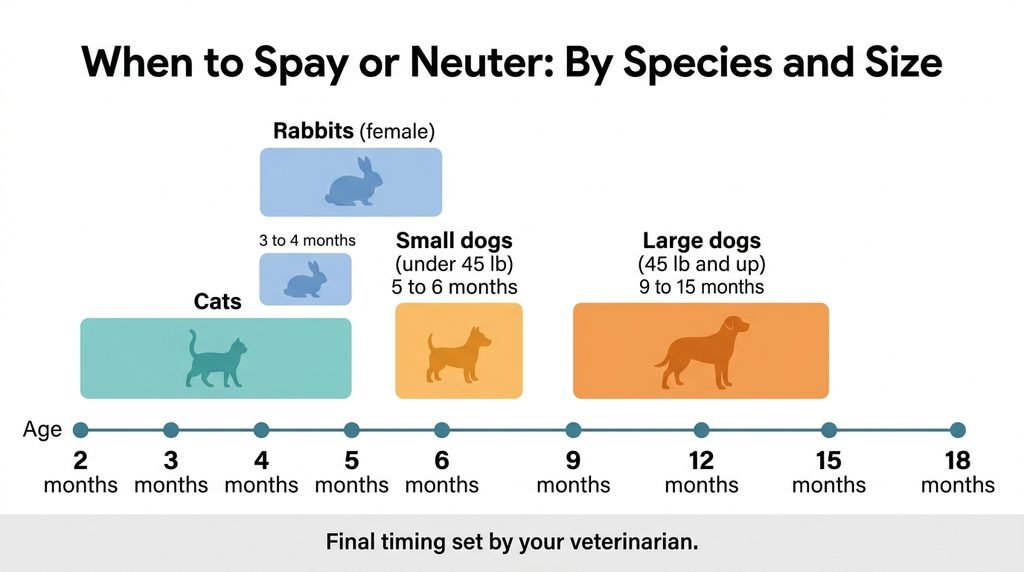
| Small breed, under 45 lb adult weight | Around 6 months | Before first heat, about 5 to 6 months |
| Large breed, 45 lb or more adult weight | After growth stops, about 9 to 15 months | About 5 to 15 months, case by case |
AAHA also tells veterinarians to use clinical discretion and talk through the trade-offs with each owner. That conversation is the part that matters most.
Best Age to Spay or Neuter a Cat
Cats are simpler. The Veterinary Task Force on Feline Sterilization, made up of feline specialists, shelter veterinarians, and breed groups, recommends spaying or neutering by five months under its Feline Fix by Five initiative. The reasoning is practical:
- Female cats can get pregnant as early as four months old.
- Spaying before the first heat lowers the risk of mammary tumors, and the large majority of feline mammary tumors are malignant.
- Intact males are far more likely to spray urine indoors and fight, which drives bite abscesses.
- The task force found no evidence that sterilizing by five months raises disease risk.
Unlike large dogs, cats do not show a meaningful joint penalty from earlier surgery. If you are looking up “cat spay near me” or “cat neuter near me” for a new kitten, four to five months is a reasonable target for most indoor and outdoor cats.
Bunny Neutering and Rabbit Spay Timing
Rabbits are where many owners are caught off guard, and it is one reason our team sees them alongside dogs and cats.
Why Female Rabbits Need Spaying
According to the House Rabbit Society, unspayed female rabbits face up to an 85% risk of reproductive cancer, with uterine changes appearing as early as 18 months. Nearly all intact females over four years old show uterine changes or tumors. Most rabbit-experienced veterinarians spay females at about four to six months.
Bunny Neutering for Males
Bunny neutering can usually happen once the testicles descend, which may be as early as 10 to 12 weeks. Many vets prefer around four months for anesthetic safety. One detail owners often miss: neutered males can stay fertile for several weeks after surgery, so keep them apart from unspayed females for at least four to six weeks.
What Makes Rabbit Surgery Different
- No overnight fasting. Rabbits cannot vomit, and withholding food can trigger gastrointestinal stasis.
- Eating and droppings are the recovery benchmark. A rabbit that has not eaten or passed droppings within about 12 to 24 hours needs a call to the vet.
- Behavior benefits are big. Fixed rabbits are easier to litter train, spray less, and bond more easily with a partner rabbit.
If you have been searching “rabbit vet near me” or “bunny vet near me,” confirm the clinic regularly anesthetizes rabbits before booking.
Early vs Traditional vs Delayed: Side-by-Side Comparison
| Factor | Early (8 to 16 weeks) | Traditional (5 to 6 months) | Delayed (9 to 18 months) |
|---|---|---|---|
| Best suited for | Shelter kittens and puppies | Cats, small and medium dogs, rabbits | Large and giant breed dogs |
| Unplanned litter risk | None | Very low | Higher, needs supervision |
| Mammary tumor protection | Strongest | Strong if before first heat | Reduced after heat cycles |
| Joint disorder risk in large dogs | Highest | Elevated | Lowest |
| Hormone-driven behavior | Never develops | Rarely develops | May need management first |
| Anesthesia and recovery | Quick in healthy young animals | Quick | Slightly longer in bigger dogs |
Behavioral Outcomes: What Changes and What Does Not
Neutering affects behaviors driven by sex hormones. It does not rewrite personality or replace training.
In a widely cited study of castrated male dogs, roaming dropped in about 90% of dogs, while mounting, urine marking, and fighting with other males dropped in roughly half to two thirds. Male cats show an even stronger response, with spraying and fighting stopping in most cats after neutering.
What neutering does not reliably fix:
- Fear-based aggression or reactivity
- Separation anxiety
- Leash pulling, jumping, and other learned habits
- Excess energy in young, high-drive breeds
A few studies have even linked gonadectomy with more fearfulness in some dogs, which is one more reason behavior alone should not drive a rushed decision. Neutered pets also burn fewer calories, so food portions usually need to come down after surgery to prevent weight gain.
How Vets Spay and Neuter a Dog: The Procedure in Plain Terms
Owners sometimes search how to spay and neuter a dog expecting a home method. There isn’t one. It is real abdominal or scrotal surgery under general anesthesia, and at a well-equipped clinic it follows a careful sequence:
- Pre-anesthetic screening. A physical exam and pet bloodwork check liver and kidney function, red cell counts, and clotting before any drugs are given.
- Anesthesia and monitoring. A breathing tube is placed, and heart rate, blood pressure, oxygen levels, and body temperature are tracked throughout.
- The surgery itself. For a spay, the vet enters the abdomen and removes the ovaries and usually the uterus. For a dog neuter, the testicles are removed through a small incision just in front of the scrotum. Undescended testicles may need an abdominal approach.
- Pain control and wake-up. Multimodal pain medication is given before, during, and after the procedure.
- Home recovery. Most pets need 10 to 14 days of restricted activity, a cone or recovery suit, and daily incision checks.
Because spaying is the more involved of the two, it is often the first veterinary surgery many families experience with a pet. For a stage-by-stage look at healing, see our breakdown of the average recovery time for pet surgery.
Case Example: Timing a Neuter for a Large-Breed Puppy
The following case example is illustrative and reflects a common scenario in our practice.
Duke, a Labrador and shepherd mix, came in at 16 weeks for his puppy visits. His owners planned to neuter him at six months because that was the age they had always heard.
At his exam, his weight curve projected an adult size of about 70 pounds, which puts him in the 30 to 39 kg category where the UC Davis data showed joint disorder rates in males roughly doubling with neutering before six months. Our veterinarian walked the family through three options: neuter at six months, wait until about 12 months, or wait until growth plates close.
The family chose to wait until 12 months. In the meantime, they managed his adolescent behavior with:
- Leash-only walks and a secure, fully fenced yard
- Basic obedience classes starting at five months
- Supervised play with other dogs
Duke had some mounting behavior during that window, which eased with training. He was neutered at 12 months after normal pre-anesthetic bloodwork and returned to full activity after his two-week recheck. His owners said the decision felt easier once they saw the data for his size, rather than following a date on a calendar.
Choosing the Right Time for Your Pet in Clovis
Questions to Bring to Your Appointment
The best age to spay or neuter your pet is a decision best made during routine pet wellness exams, when your vet can track growth and body condition. Come ready to ask:
- What adult weight does my puppy’s growth curve predict?
- Is my breed on the higher-risk list for joint disease, cancer, or incontinence?
- Can I safely manage an intact pet at home until the recommended age?
- If my female dog goes into heat first, how long should we wait before surgery?
- For rabbits, how often does the clinic anesthetize rabbits?
If you would like to talk it through with the veterinarian who will perform the procedure, you can learn more about our pet doctor and surgical background before you visit.
Local Considerations for Clovis Pet Owners
Clovis summers are long and hot, and recovery means 10 to 14 days without running, swimming, or rough play. If your timing is flexible, many families find exercise restriction easier to manage outside the hottest stretch of the year. Watch the incision daily for redness, swelling, discharge, or gaps, and if something looks wrong after hours, our same-day vet care team can see post-surgical concerns quickly.
When you are ready to plan, our spay and neuter clinic offers pre-surgical screening, monitored anesthesia, and clear aftercare instructions for dogs and cats, and we are happy to discuss rabbit timing as well. You can request a vet appointment near me online or call us at (559) 298-6509. We are located at 585 W Shaw Ave, Clovis, CA 93612. If you are still weighing options, our guide to spay and neuter near me covers what to expect on surgery day.
The right age is not the youngest or the oldest one. It is the one that fits your pet’s species, size, sex, and household, chosen with a veterinarian who knows the research.
Frequently Asked Questions
-
What is the best age to spay or neuter a dog?
It depends on expected adult size. AAHA guidance suggests about six months for small-breed males and five to six months for small-breed females, before the first heat. For dogs expected to weigh 45 pounds or more, neutering males after growth stops, around 9 to 15 months, lowers joint disorder risk. Large-breed females are timed case by case. If you are searching for a neuter dog near me option, ask the clinic to review your puppy’s growth curve first.
-
What is the difference between spay vs neuter?
Spaying is surgery for females that removes the ovaries and usually the uterus. Neutering is surgery for males that removes the testicles. Both prevent pregnancy and reduce sex hormones, but a spay is an abdominal procedure, so it typically takes longer and needs slightly more recovery time. People often say “neuter” for both sexes, which causes confusion. Your veterinarian will explain which procedure your pet needs and how to prepare them for surgery day.
-
When should I spay or neuter my cat?
Most veterinarians now recommend spaying or neutering cats by five months of age, following the Feline Fix by Five recommendation. Female cats can become pregnant as young as four months, and spaying before the first heat lowers mammary tumor risk. Early neutering also reduces urine spraying and fighting in males. Unlike large dogs, cats show no meaningful joint penalty from earlier surgery, so there is little reason to delay in a healthy kitten.
-
At what age should a rabbit be spayed or neutered?
Female rabbits are usually spayed between four and six months, which protects them from reproductive cancers that affect most intact females by middle age. Males can be neutered once the testicles descend, often around three to four months. Neutered males may remain fertile for several weeks, so keep them away from unspayed females for at least a month. Choose a clinic experienced with rabbit anesthesia, and never fast a rabbit before surgery.
-
Will neutering calm my dog down?
Neutering reduces behaviors driven by testosterone, such as roaming, urine marking, mounting, and fighting with other males. It does not change basic temperament, fear-based reactivity, or high energy in young working breeds. Many adolescent dogs settle with age and training regardless of surgery timing. If calmer behavior is your main goal, pair neutering with consistent training, daily exercise, and mental enrichment, and talk with your vet about whether waiting a few months makes sense for your breed.
-
Can a dog be spayed while in heat?
Most veterinarians prefer to wait two to three months after a heat cycle ends before spaying. During heat, blood supply to the uterus and ovaries increases, which makes surgery longer and raises bleeding risk. Spaying during heat is possible when there is a medical reason, but routine spays are usually scheduled once hormone levels return to baseline. Keep your dog away from intact males during and right after her cycle to prevent an unplanned pregnancy.
-
How do I find a trusted spay and neuter vet near me in Clovis?
Look for a clinic that runs pre-anesthetic bloodwork, monitors heart rate, oxygen, blood pressure, and temperature during surgery, uses multimodal pain control, and gives clear written aftercare. Ask whether a veterinarian discusses timing based on breed size rather than a fixed age. Alta Animal Hospital at 585 W Shaw Ave in Clovis offers all of this. Call (559) 298-6509 to talk with our team about the right timing for your pet.
Timing is a medical decision, not a calendar date. Talk it through, and your pet gets the benefits without the avoidable risks.