
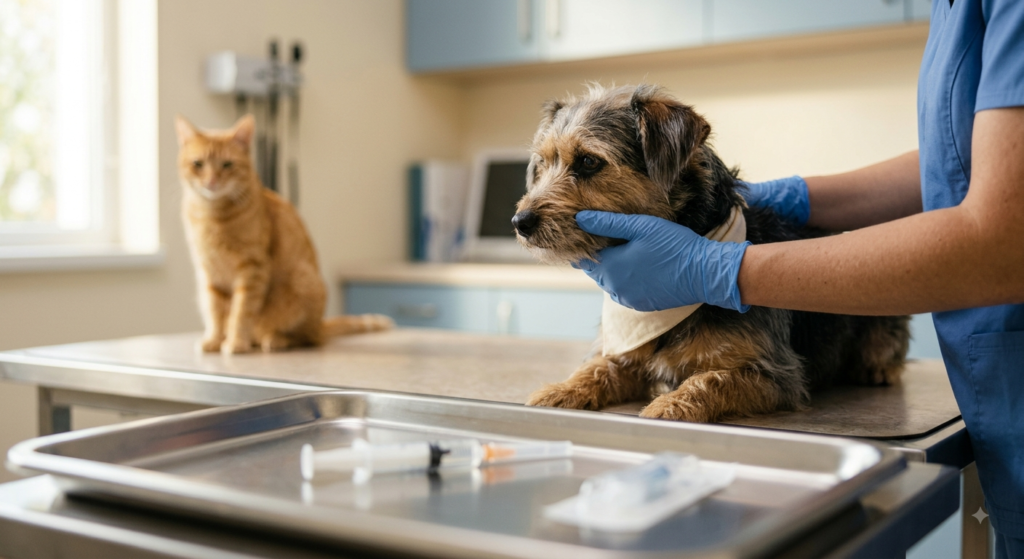
A collar can slip off. A tag can fall off or fade until it is unreadable. A microchip cannot do either of those things, which is exactly why it has become the standard for permanent pet identification. If you have been searching for pet microchipping near me in Clovis, CA, this guide walks through how the chip works, what happens during the implant appointment, how registration works, the lookup tools shelters and vets actually use, and what California law says about the procedure. Alta Animal Hospital offers microchipping as part of routine visits for dogs, cats, and other companion animals throughout Clovis and the greater Fresno area.
What a Pet Microchip Actually Is
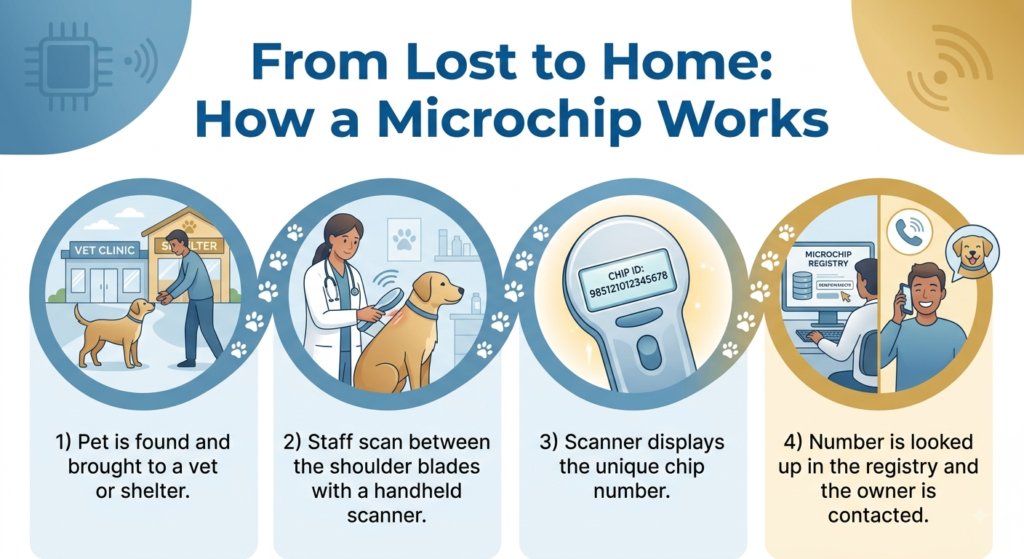
A microchip is a small electronic transponder, roughly the size of a grain of rice, encased in biocompatible glass. It does not have a battery and it does not track your pet’s location in real time, despite a common misconception. Instead, it stores a unique identification number that becomes readable when a handheld scanner passes over it, using a technology called radio-frequency identification. When a lost pet arrives at a shelter or veterinary clinic, staff scan the area between the shoulder blades, where the chip is placed, and the scanner displays that unique number. Staff then look up the number in a pet microchip registry to find the owner’s contact information.
This is the core reason microchips work so well for reunification. A collar tells a stranger nothing once it is gone, but a microchip is permanently linked to the animal itself.
The Implant Process at the Vet
Getting a dog chipped, or a cat, rabbit, or other companion animal, is a quick procedure that most pets tolerate with little more reaction than a routine vaccination. Alta Animal Hospital’s microchipping and identification service is available as a standalone walk-in visit or combined with another appointment.
- A veterinary team member loads a pre-sterilized microchip into a syringe-style applicator
- The chip is injected just under the skin between the shoulder blades using a needle slightly larger than a standard vaccine needle
- The entire injection takes only a few seconds
- No sedation or anesthesia is required for a standalone microchipping visit
- Many pet owners choose to combine microchipping with an existing wellness exam, spay or neuter surgery, or vaccination appointment so their pet only needs one visit
Once implanted, the chip stays in place for the animal’s lifetime under normal circumstances. It does not need to be replaced, charged, or maintained.
Registering Your Pet’s Microchip
Implanting the chip is only half the job. A chip that has never been registered, or one with outdated contact information, cannot reunite a lost pet with its family, because the number only leads back to whatever information was entered into the registry.
Pet microchip registration typically involves the following steps:
- Your veterinary team implants the chip and provides you with the unique chip number and the manufacturer’s registry information
- You create an account with the manufacturer’s registry, or with a universal registry, and enter your name, address, and phone number
- You add your pet’s basic details, including species, breed, and a current photo if the registry allows it
- You review and confirm the submitted information for accuracy
- You revisit the registry any time your phone number, address, or pet ownership status changes
A study cited by the American Animal Hospital Association found that a large share of microchipped animals in shelters were never successfully reunited with owners specifically because the registration was incomplete or the contact details were out of date. Registering the chip, and keeping it current, is not optional if you want the chip to actually work when it matters.
Dog Microchip Lookup and Pet Microchip Lookup Tools
If you already have a pet with a chip but are not sure where it is registered, or you found a stray animal and want to help reunite them with their family, a pet microchip lookup tool can identify which registry holds the chip’s information. The American Animal Hospital Association maintains a Universal Pet Microchip Lookup tool that searches across multiple manufacturer databases at once using the chip number alone. Most veterinary clinics, including ours, use a similar universal scanner and lookup process any time a stray or lost pet is brought in.
If you do not know your own pet’s chip number, your veterinarian can scan your pet during any visit and provide the number, along with guidance on which registry to check or update.
Reunification Statistics: Why Microchips Matter
The value of microchipping is not anecdotal. A widely cited study published in the Journal of the American Veterinary Medical Association, which reviewed thousands of stray animals entering shelters, found a significant difference in return-to-owner rates between microchipped and non-microchipped animals.
| Animal Type | Returned to Owner Without a Microchip | Returned to Owner With a Microchip |
|---|---|---|
| Dogs | 21.9% | 52.2% |
| Cats | 1.8% | 38.5% |
The gap is even more dramatic for cats, largely because far fewer cats wear collars or tags day to day compared to dogs. A microchip removes that dependency entirely, since it stays with the animal regardless of what they are or are not wearing when they go missing.
California Microchipping Laws and Local Requirements
California does not have a single statewide law requiring every pet to be microchipped, but the state’s regulatory landscape strongly encourages it. AB 1634, known as the California Responsible Pet Ownership Act, tied microchipping into the state’s broader spay and neuter enforcement framework, and many California cities and counties, including jurisdictions across the Central Valley, have their own municipal ordinances that require dogs and cats to be microchipped, particularly animals adopted from a shelter or rescue. California law also requires that shelter and rescue animals be microchipped and that the chip be registered to the new owner before an adoption is considered complete.
Because requirements can vary by city and county, and because microchipping is frequently required as part of a spay and neuter procedure for shelter-adopted pets, it is worth confirming your specific local requirements with your veterinarian or local animal control agency, in addition to registering the chip itself.
Microchip vs Collar and ID Tag: A Comparison
Most veterinarians recommend using both forms of identification together rather than choosing one over the other.
| Factor | Collar and ID Tag | Microchip |
|---|---|---|
| Visibility to a stranger | Immediate, readable at a glance | Requires a scanner to read |
| Can be lost or removed | Yes, collars slip off or break | No, implanted permanently under the skin |
| Requires registration to work | No | Yes |
| Effective if pet is found far from home | Only if tag is still attached | Yes, as long as the chip is registered |
| Best used | For everyday, immediate identification | As permanent, tamper-proof backup identification |
What Influences the Cost of Microchipping a Dog or Cat
The question of how much it costs to microchip a dog or cat comes up often, and the honest answer is that it depends on several factors: whether the procedure is done as a standalone visit or combined with another appointment such as a wellness exam or spay and neuter surgery, which chip manufacturer and registry is used, and whether lifetime registration is included with the chip itself. Rather than quoting a flat number here, the most accurate way to get current information is to contact our team directly, since pricing can vary based on what is included with your pet’s specific visit.
Patient Case Study: Milo’s Return Home
A Clovis client’s cat, Milo, slipped out through a screen door during a home repair visit and was missing for four days. Milo had been microchipped as a kitten during his initial wellness series, and his owner had registered the chip but had not updated it after a move to a new address across town the year before.
When a neighborhood resident found Milo and brought him to a local shelter, staff scanned him immediately and located the chip number, but the registered address led to Milo’s previous home. Because the phone number on file was still current, shelter staff were able to reach the family directly, and Milo was reunited with his owner that same day. His case is a clear example of why keeping registration information current matters just as much as getting the chip implanted in the first place.
When to Get Your Pet Microchipped
Microchipping can be done at nearly any age or life stage.
- Puppies and kittens can typically be microchipped starting around six to eight weeks of age, often during an early wellness visit
- Adult dogs and cats adopted without a known microchip history can be chipped at any age during a routine exam
- Pets undergoing spay or neuter surgery are frequently chipped during the same anesthetic event, since the animal is already sedated
- Senior pets without an existing chip benefit just as much from permanent identification as younger animals, particularly if they have any history of wandering or escaping
Visit Our Full-Service Clovis Animal Hospital
Microchipping is one part of a broader approach to keeping pets safe throughout their lives. The team at Alta Animal Hospital has served Clovis and the surrounding Central Valley community since 1978, and our About Us page has more on our history and approach to care. You can also browse our full range of veterinary services to see how microchipping fits alongside wellness exams, vaccinations, and surgery.
A microchip only protects a pet as well as the registration behind it, so implanting the chip is the first step, not the last one.
Frequently Asked Questions
-
Does a pet microchip work like a GPS tracker?
No. A microchip does not contain a battery, does not transmit a signal, and cannot show you your pet’s real-time location on a map. It only stores a unique identification number that becomes readable when a handheld scanner is passed directly over it. Real-time location tracking requires a separate GPS collar device, which serves a different purpose than permanent identification.
-
Is microchipping painful for my dog or cat?
Most pets react to microchipping about the same way they react to a routine vaccination, a brief pinch followed by no lasting discomfort. The needle used is slightly larger than a standard vaccine needle, but no sedation is required for the injection itself. Many owners combine the procedure with an existing wellness visit or spay and neuter surgery so their pet only experiences one appointment.
-
How do I register my pet’s microchip after it is implanted?
Your veterinary team will give you the unique chip number and the manufacturer’s registry details right after the implant. From there, you create an account with that registry, or a universal registry, and enter your current contact information along with your pet’s basic details. It is important to revisit that registration any time your phone number or address changes, since outdated information is the most common reason microchipped pets are not successfully reunited with their owners.
-
What should I do if I find a lost pet with a microchip?
Bring the animal to a veterinary clinic, animal shelter, or animal control facility so staff can scan for a chip using a universal scanner. If a chip is found, staff can use a pet microchip lookup tool to identify the registry holding the owner’s contact information and begin the reunification process. Never attempt to remove or tamper with a microchip, since doing so is unnecessary and can injure the animal.
-
Is microchipping required by law in California?
There is no single statewide law requiring every pet in California to be microchipped, but many cities and counties have their own local ordinances requiring it, and animals adopted from a California shelter or rescue must be microchipped and registered before the adoption is finalized. Because rules vary by jurisdiction, it is worth confirming your specific local requirements with your veterinarian or local animal control agency.
-
Can an old or unregistered microchip still help find my pet?
An implanted chip can still be scanned and its number read even if it was never registered or the registration lapsed, but staff will not be able to identify an owner from an unregistered number alone. If you are unsure whether your pet’s chip is registered or if the information is current, ask your veterinarian to scan your pet and help you check or update the registry during your next visit.